Factnameh Confirms At Least 950 Bodies in Just Two Days at Tehran Morgue
How body-bag serial numbers expose the true human cost of state violence

Warning: This report references images and videos containing deceased individuals.
On January 18, 2026, Iran’s state broadcaster (IRIB) aired and published a report titled “An Autopsy of a Lie.”
The report was broadcast domestically as part of an effort to promote the government’s narrative about the killings of January 2026. In the video, an IRIB reporter visits the Legal Medicine Organization facility in southern Tehran to explain the numbers written on body bags at the morgue.
The video appears to be a response to questions raised about the serial numbers visible on the body covers of victims killed on January 8 and 9. In the same context, state television also aired an interview with the head of Iran’s Legal Medicine Organization, suggesting that Iran International’s reported figure of “12,000 killed” may have been calculated based on serial numbers seen on body bags at forensic facilities.
Iran International has previously rejected this claim, stating that its figure was based on information from sources inside the Iranian government, including “a source close to the Supreme National Security Council, two sources in the presidential office, and accounts from several sources within the Islamic Revolutionary Guard Corps.” The outlet has not cited body-bag serial numbers as the basis for its reporting. It has also been stated that the figure refers to nationwide deaths, not just Tehran.
Regardless of that dispute, a closer reading of IRIB’s own report and the documents shown by its reporter allows for an independent estimate of how many bodies were transferred to the Kahrizak forensic facility on January 8 and 9.
In a previous in-depth investigation, based on analysis of publicly available videos, Factnameh estimated that the morgue facilities at Kahrizak have a maximum capacity of roughly 800 bodies.
Both the IRIB report and the interview with the head of the Legal Medicine Organization confirm that bodies are numbered using a simple annual serial system: each year begins with serial number one, and every body admitted to the facility receives the next consecutive number.
This means that by comparing two figures—the serial number just before the crackdown began and the highest serial number observed on January 9—it is possible to estimate how many bodies were officially referred to Tehran’s forensic system during that period.
According to footage shown in the IRIB report, the serial number for a routine, non-protest-related death on January 7, before the crackdown began, was 11,607 (at 1:24 in the video).
On January 8, a serial number of 11,773 is visible (0:52), and on January 9, a serial number of 12,166 appears (3:03).
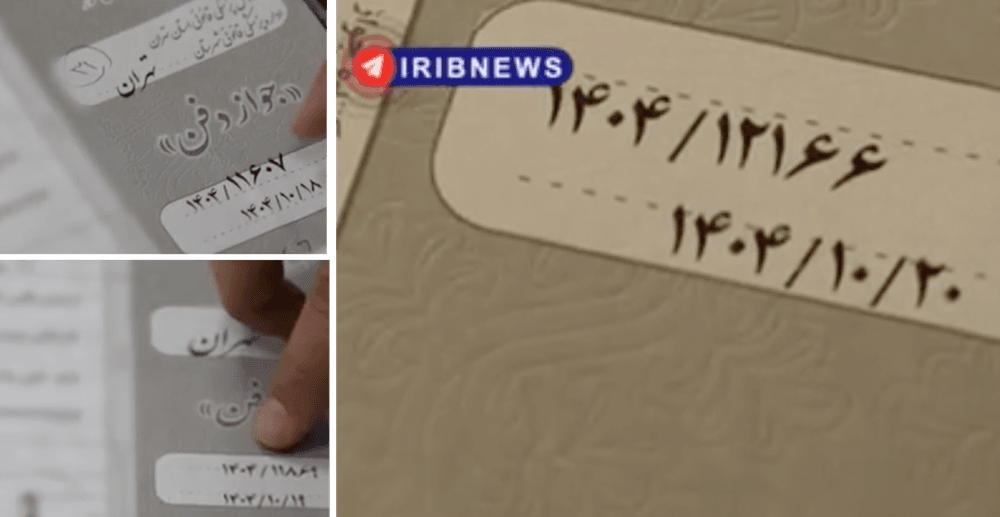
Based solely on the figures shown in IRIB’s own report, this confirms that by January 9 at least 559 bodies had been transferred to the Kahrizak facility.
But this is not the full picture. Factnameh’s review of videos posted on social media reveals even higher serial numbers. In one video dated January 9 from Kahrizak, the serial number 12,554 is clearly visible (at second 20 of a 26-second clip). Other videos from the same day show similarly high numbers.
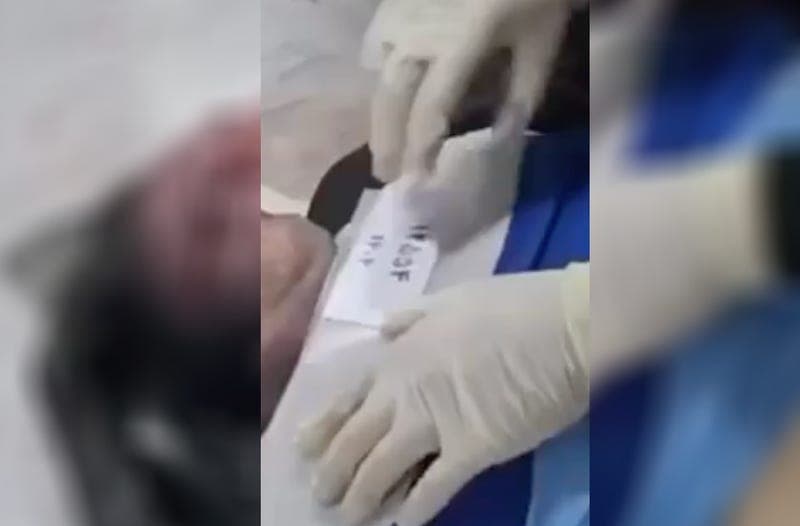
If the baseline number of 11,607 is subtracted from the highest observed serial number, 12,554, this indicates that by the evening of January 9, at least 947 bodies had been registered at the Kahrizak forensic facility.
This figure reflects only the cases officially recorded at Kahrizak on January 8 and 9. When accounting for victims registered at other forensic facilities across the country (or those never referred to forensic institutions at all), the real death toll is likely significantly higher.
It remains unclear whether all bodies transferred to Kahrizak came from Greater Tehran or from elsewhere in Tehran Province. The IRIB video mentions the city of Shahriar, and social media footage shows body-transport vans marked “Shahedshahr,” a city in Shahriar County.
According to IRIB’s report, under normal conditions, 40 to 50 bodies are transferred daily to the Kahrizak forensic facility by judicial order. At minute 2:30 of the report, a document showing the final death registrations of the year 2024 is displayed, bearing the serial number 13,819. Both the IRIB reporter and the Kahrizak forensic official confirm that this means 13,819 bodies entered the facility over the course of that year—an average of 38 bodies per day sent to Kahrizak for identification and determination of cause of death.