Who Had Access to the Internet During the Shutdown?
An analysis of whitelisted Telegram channels during Iran's internet blackout.
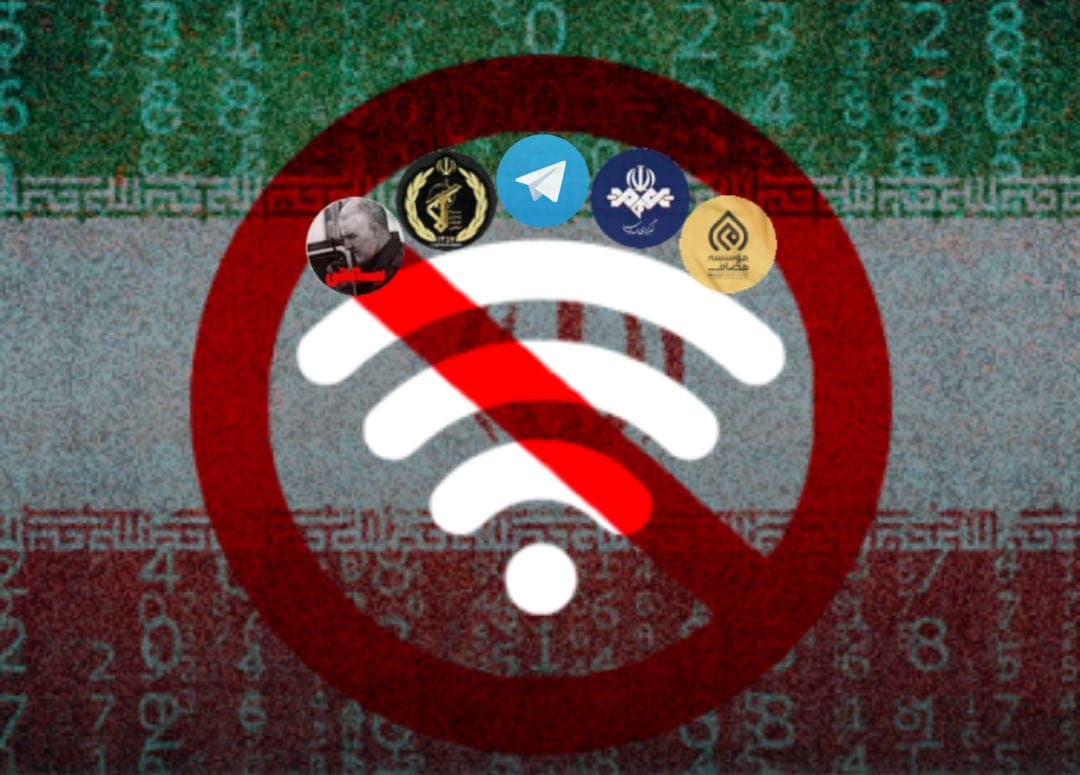
Summary
- On the evening of January 8, 2026, Tehran time, coinciding with the suppression of popular protests against the Islamic Republic, the internet in Iran was shut down. The extent of the communication cutoff was so severe that even the activity of the Islamic Republic’s second official media, IRNA, was halted. However, 14 political news Telegram channels inside Iran continued to operate: IRIB News Agency, Tasnim, Afsaran Jang-e Narm Channel, Mehr News Agency, Bisimchi Media, Serfan Jahate Ettela Channel, Masaf (Raefipour), IRGC Channel, Young Journalists Club (YJC), Fars News Agency, Daneshjoo News Agency, SaberinFa and Saberin\_ir channels (likely affiliated with Hashd al-Shaabi forces), and Defa Press Channel (affiliated with the General Staff of the Armed Forces).
- During the first three days of the internet shutdown, among the official media Telegram accounts, only IRIB News Agency, Tasnim, Fars, and Mehr had internet access. Among unofficial news channels, a few were also active: Afsaran Jang-e Narm, Bisimchi Media, IRGC Channel, and Masaf. These channels are believed to be affiliated with the IRGC, despite the IRGC’s denial of any relationship.
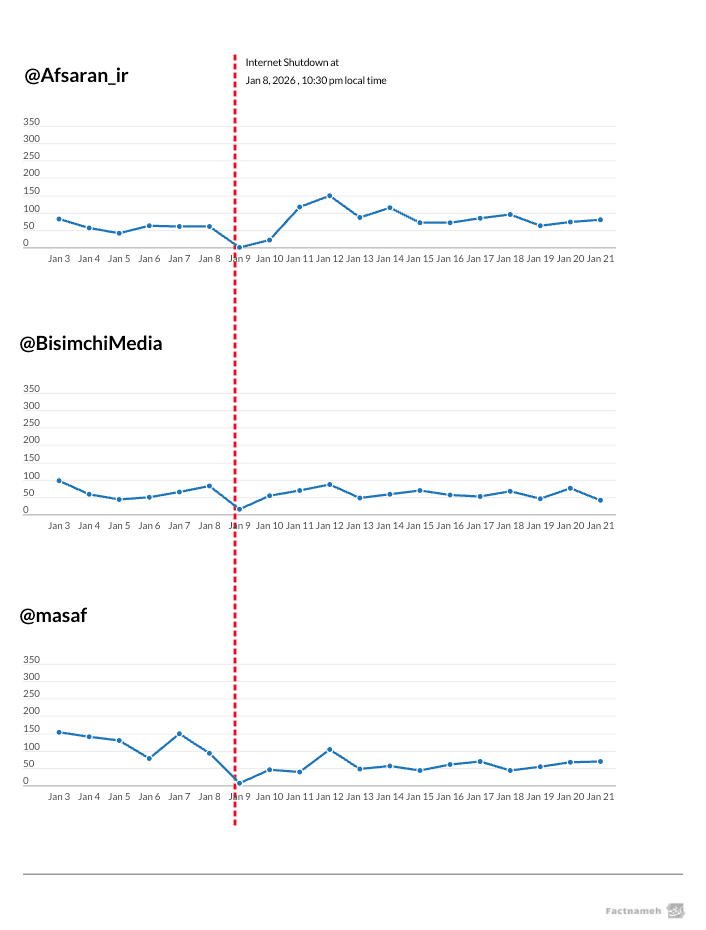
- The Masaf Channel on Telegram, affiliated with Iranian commentator Ali Akbar Raefipour, remained active during the blackout. This may suggest that the Islamic Republic’s security officials have more trust in Raefipour’s channels than in the IRNA and ISNA news agencies.
- Most of the Telegram posts published in the first three days of the internet shutdown were videos and images produced by IRIB, which were subsequently reposted in the other active channels using similar language.
- Textual data analysis of posts published across the 14 government-sanctioned Telegram channels shows that the pattern of wording repetition is observed in over 80% of the posts.
- Most of these posts contained similar short texts, often adding the channel address and emojis to the beginning and end of the text, or sometimes slightly altered.
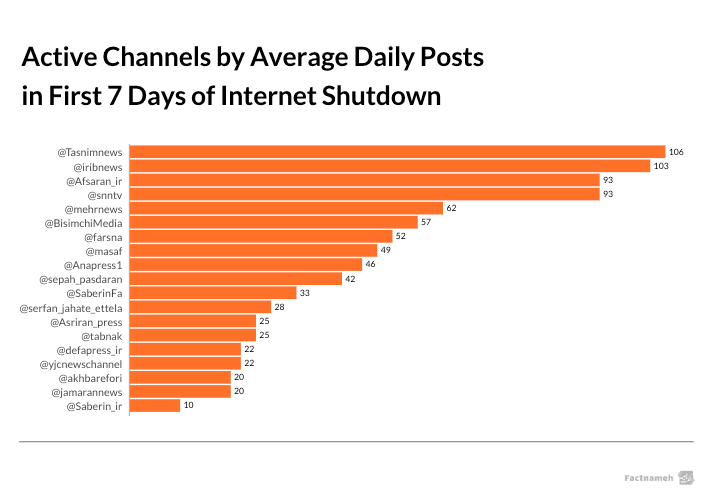
- By the seventh day of the internet shutdown, there were a total of 19 active Telegram channels. Notably, channels of news sites affiliated with political groups (Asr Iran, Tabnak, Jamaran, Akhbar Fori (Immediate News), Anapress, and Khabar Online channels) were reactivated on January 12 and 13, prior to the reactivation of some official media channels.
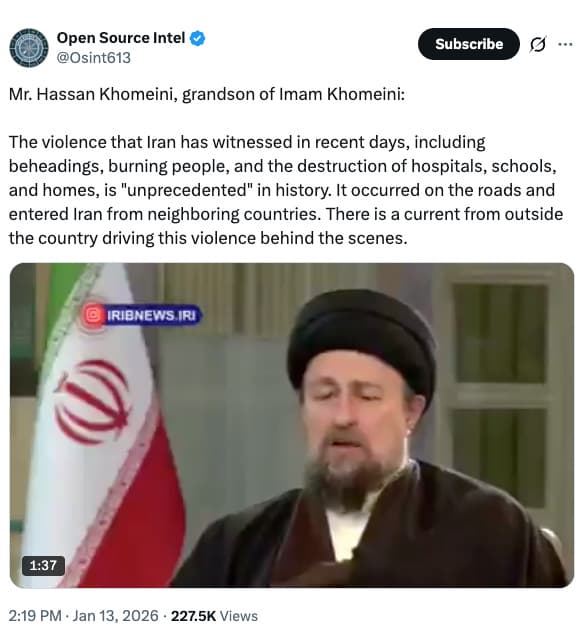
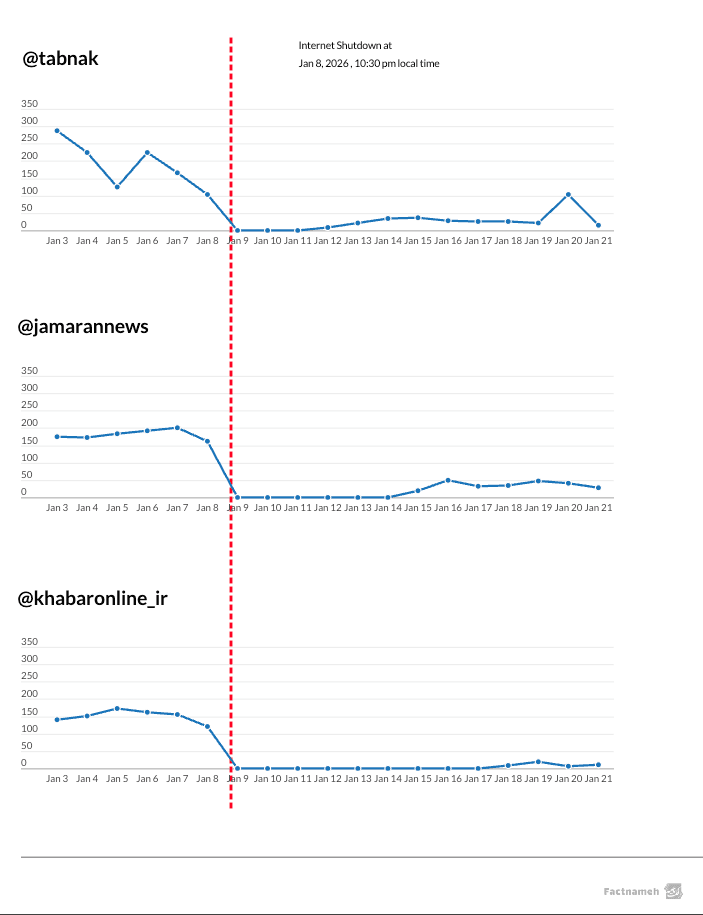
- A significant discovery here is how some of these channels’ reactivation coincided with the releases of public statements against protesters made by the respective individuals behind the channels. For example, Hassan Khomeini issued a statement against the protests on January 13, 2026, and the Jamaran channel, which is related to Khomeini’s office, resumed activity on the same day.
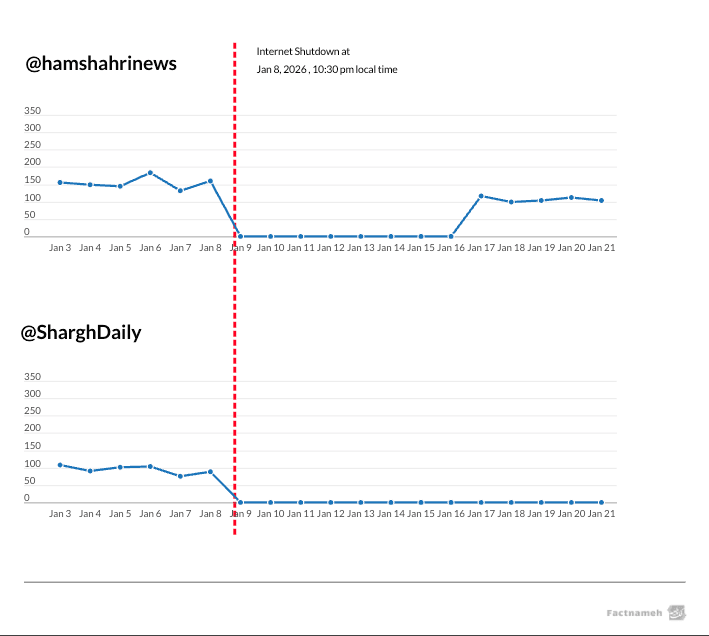
- After 10 days, a greater number of official media has resumed–or at least partially resumed in the case of Shargh, Hamshahri, and news agencies like ISNA–activity on Telegram.
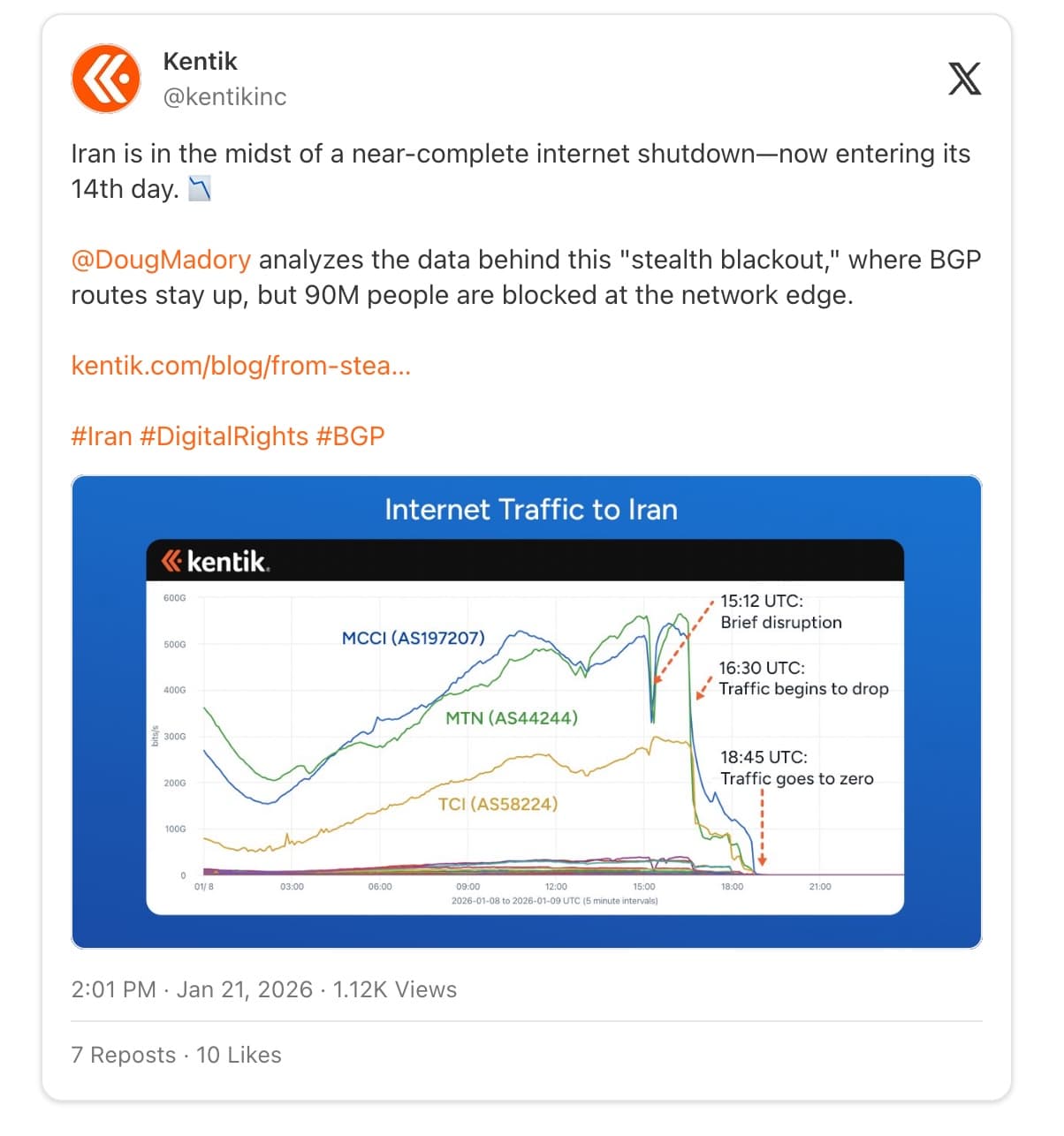
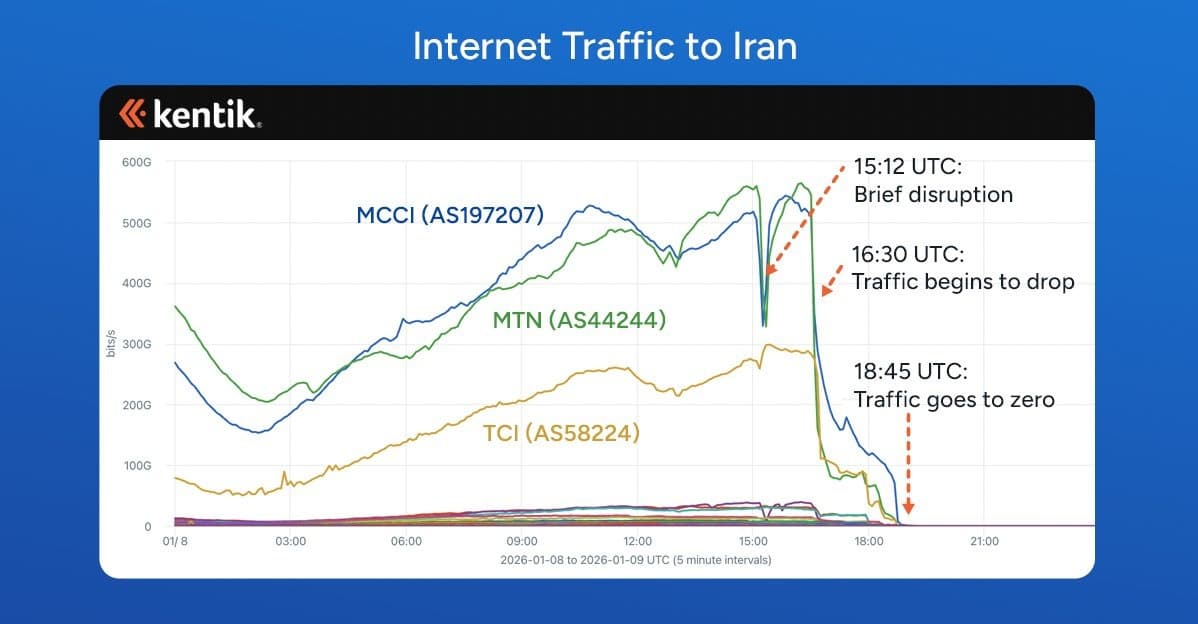
On January 8, 2026, after several hours of severe internet disruption, Iran’s connection to the global internet was fully cut at 10:45 a.m. Tehran time. While most institutions and media outlets lost connectivity, a limited number of groups remained online.
Who were they?
Internet shutdown during protests has been a common practice in Iran. However, the January 2026 blackout was unprecedented in terms of the scope of the outage. In the past, including the protests of November 2019, Mahsa Amini protests in 2022, and during the Iran-Israel War in June 2025, internet access for institutions, official media, and individuals trusted by the government were usually unaffected. This time, however, the shutdown affected many official groups and media outlets, to the extent that even the access of the Islamic Republic News Agency (IRNA), the largest official public media after IRIB, and many media outlets affiliated with the government and sovereign institutions were cut off.
While the Islamic Republic News Agency (IRNA) was cut off, which groups and media outlets still had access?
We can draw the answer from our analysis of 50,000 posts published across 48 active, high-follower Telegram news channels between January 3 and January 21, 2026. These crucial insights not only illustrate the whitelisted media stakeholders during the blackout, they give us a fuller picture of how Iran’s new security-media apparatus operates under crises.
(Download raw data in CSV format)
Data analysis notebook and raw data are available at Factnameh Github
- Identification of Active Channels During the Internet Shutdown
We identified a list of 251 active Telegram news channels that have a large following and are related to Iran (in terms of membership, view statistics, forward rate, and growth). After filtering out accounts that are managed outside of Iran and imposing a threshold of at least 20,000 channel members, we narrowed down our focus to 48 channels* eligible for analysis. These selected channels can be broadly divided into three groups:
Group 1, Major official media affiliated with the government or major ruling institutions, such as IRNA, ISNA, Mehr, Fars, Tasnim, IRIB News Agency, YJC, and others.
Group 2, Newspaper channels and news sites such as Shargh Newspaper, Etemad Online, Hamshahri, Khabar Online, Tabnak, Asr Iran, Eslahat News, Jamaran, Mashregh News, Raja News, and popular news channels operating under titles like Akhbar Fouri.
Group 3, Channels affiliated with political, military, and security groups and circles within the Islamic Republic, such as Afsaran Jang-e Narm (Soft War Officers), IRGC Channel, Saberin News, Bisimchi Media, Masaf, Defa Press, Nour News, and even some reformist channels like the Pezeshkian Supporters Channel, etc.
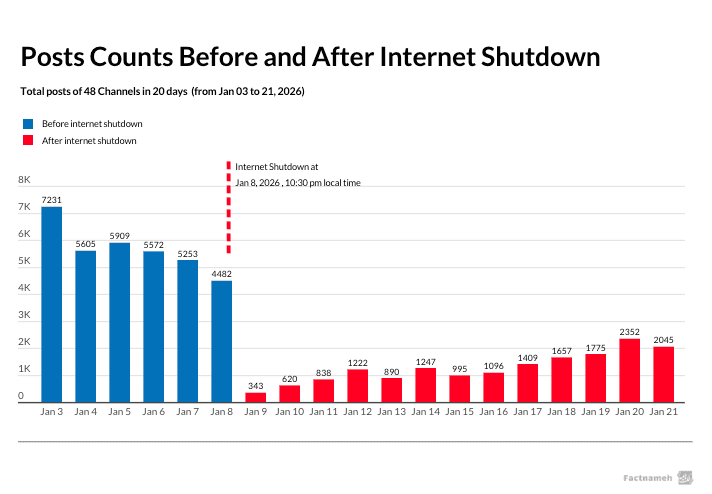
Before the internet shutdown, these 48 channels collectively published more than 5,000 posts on a daily basis. This number dropped to about 340 on January 9, 2026 and increased again after one week to about 1,000 posts per day. Each of these channels, however, showed different levels of activity during the shutdown.
- Analysis of Channel Activity Statistics During the Internet Shutdown
For analysis, we divided the internet shutdown period into three phases: Very Severe Shutdown (first three days), Severe Shutdown (first week), and Gradual Recovery (two-week period).
During the “Very Severe Shutdown” period, only 14 channels out of the 48 showed continuous activity:
- IRIB News Agency
- Tasnim
- Afsaran Jang-e Narm Channel
- Mehr News Agency
- Bisimchi Media
- Serfan Jahate Ettela Channel
- Masaf Channel (Raefipour)
- IRGC Channel
- YJC
- Fars News Agency
- Daneshjoo News Agency
- Defa Press Channel (attributed to the General Staff of the Armed Forces)
- SaberinFa and Saberin\_ir channels (likely affiliated with Hashd al-Shaabi forces).
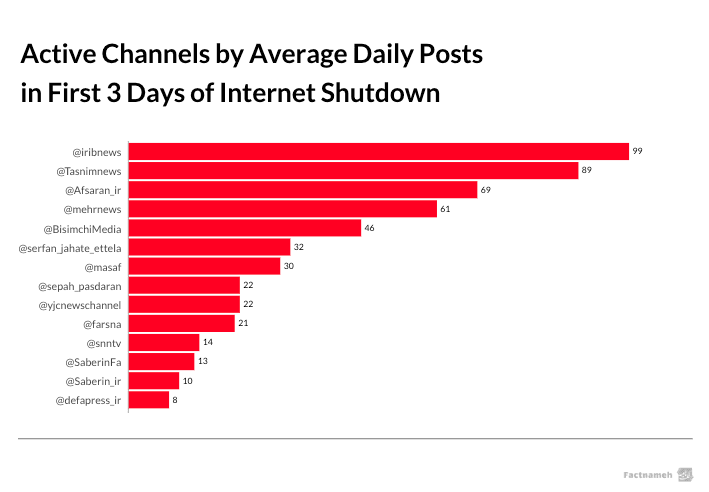
The composition of these 14 channels is noteworthy. On one hand, we saw some official media channels (Group 1), such as theIRIB News Agency, YJC (affiliated with IRIB), Tasnim, Fars (affiliated with the IRGC), Mehr (affiliated with the Islamic Development Organization), and to some extent Daneshjoo News Agency (affiliated with Basij).
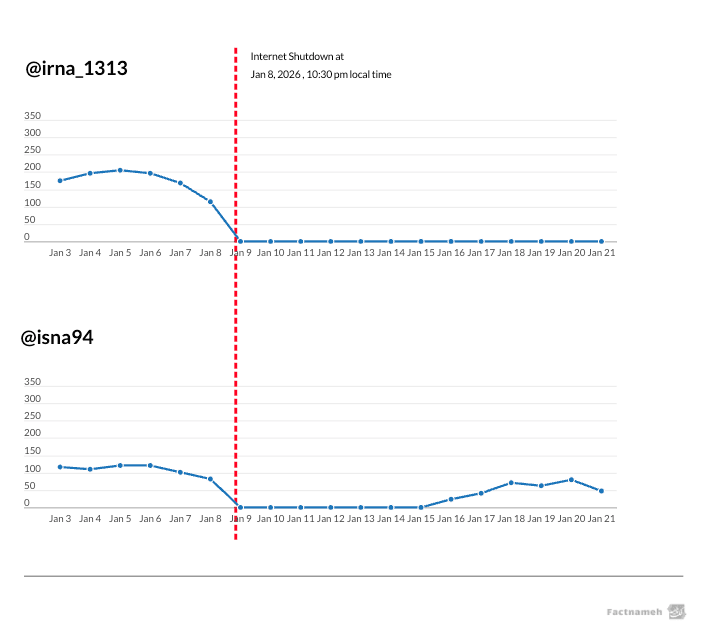
On the other hand, there are unofficial channels affiliated with some military and security institutions (Group 3): Afsaran Jang-e Narm, Bisimchi Media, Masaf (Raefipour), IRGC Channel, and Saberin News channels. While these accounts stayed online, the Telegram channel of the country’s second official media, IRNA, stayed in the dark and was not reactivated until 10 days after the internet shutdown.
A highlight from the first three days (Very Severe Shutdown period) was the volume of activity of the unofficial channels. The activity level of some of these channels increased, rather than decreased, compared to periods before the shutdown. For example, on the Afsaran Jang-e Narm Channel, the average number of posts per day was 60 prior to the blackout and 69 in the first three days of the shutdown.
By the seventh day of the internet shutdown, the total number of active channels increased to 19 after secondary news sites, Asr Iran, Tabnak, Jamaran, Akhbar Fori, and Anapress (affiliated with Islamic Azad University) were reactivated.
Another significant discovery here is how some of these channels’ reactivation coincided with the releases of public statements against protesters made by individuals behind the channels. For example, Hassan Khomeini issued a statement condemning the protests on January 13, 2026, and the Jamaran channel, which is related to Khomeini’s office, resumed activity on the same day.
https://x.com/Osint613/status/2011156222226153937?s=20
https://x.com/Osint613/status/2011156222226153937?s=20
Official media like IRNA, ISNA, and news channels like Shargh, Hamshahri, Etemad, Khabar Online only slowly joined the list of active channels over the following week.
The following section details the activities of selective channels across different categories, from official media and unofficial IRGC-affiliated channels to major government media like ISNA and IRNA, as well as newspapers and news sites.
1- Trusted official media news channels
IRIB News Agency, Tasnim, and Mehr Channels
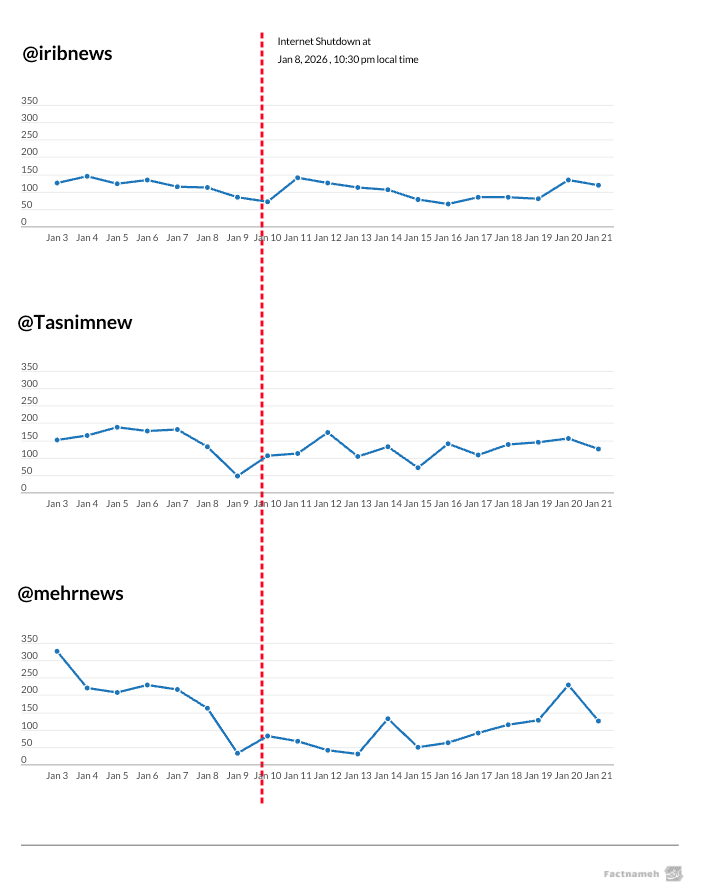
The following charts show that the three official media news Telegram channels had a decrease in published posts on January 8 and 9, 2026, but their activity resumed afterwards. In the first days of the internet shutdown, IRIB News Agency played a leading role, but soon after, Tasnim and Mehr news agencies became more active.
2- Extreme and unofficial IRGC-related channels:
Masaf Channel, Bisimchi Media, and Afsaran Jang-e Narm Channels
The following charts show that, amidst the internet shutdown and silence from official media, unofficial channels affiliated with military and security institutions effectively played the role of an alternative media.
3- Untrusted official media news channels:
ISNA and IRNA Channels
Activity on the Islamic Republic News Agency (IRNA) channel came to a halt as the internet shutdown was enacted. Nothing was published on this channel until January 21, 2026. The ISNA channel, although also stayed offline for the first seven days of the blackout, resumed its activity on January 15, 2026.
4- Newspapers:
Shargh and Hamshahri Newspaper Channels
Shargh Newspaper channel stayed offline until January 21, 2026, while Hamshahri Newspaper channel resumed its activity on January 16, 2026.
5- Semi-official news channels:
Jamaran, Tabnak, and Khabar Online Channels
These channels had a somewhat similar behavior before the internet shutdown, but the timing of their return varied. As mentioned above, the reactivation of some of these channels coincided with the release of anti-protest comments made by government officials associated with the channels.
- Content Analysis on the First Three Days of the Internet Shutdown
Given the scale of the blackout and the low number of active (official, unofficial, and IRGC-affiliated) Telegram channels, it can be said with relative certainty only a very small number of IRGC-affiliated networks were connected to the global internet.
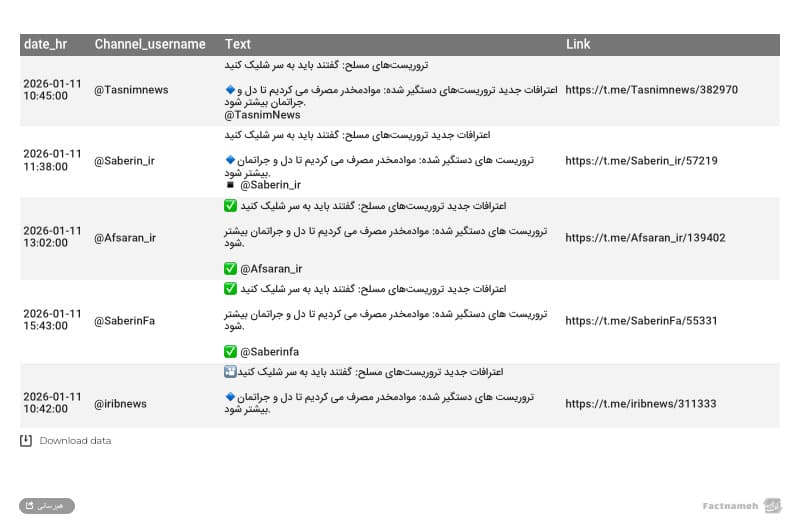
In terms of messaging employed by channels that stayed online, our analysis shows that the content produced by these media was practically identical. Out of a total of 1,191 posts published in the first 3 days of the internet shutdown, 720 posts contained text. 80% of these posts had a word repetition rate above 50%.
A table listing the posts that shared a high word repetition rate is available for download below.
https://infogram.com/fc-reporttgwc-02-1hnp27eq7ropy4g
These posts are highly similar because they are mostly reposts of images and videos produced and broadcast by IRIB. The text on them is typically very short, consisting of only a few words. Each channel, when republishing the IRIB materials, put its channel name and a few emojis at the beginning and end of the post to create some slight differences.
The original source of most of these posts seemed to be the IRIB Central News Unit channel, which indicates the flow of information and the central nodes of Iran’s content dissemination apparatus.
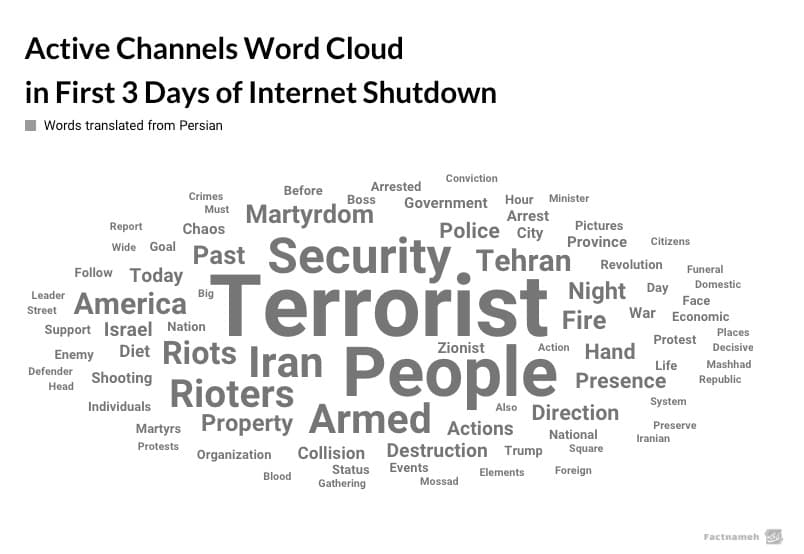
The combination of words used in these posts clearly reflects the content approach of these channels.
- Comparison with the Iran-Israel War (June 2025)
To understand how Iran’s information manipulation apparatus might have shifted over time, we compared the Telegram activity patterns during the January 2026 shutdown with that of June 2025, during the Iran-Israel War.
To recap: Back in June 2025, severe internet disruptions in Iran started at the beginning of the Israeli attack on June 13, and on June 18, 2025, a complete internet shutdown was reported.
We extracted all Telegram posts from the same 48 active news channels published between June 13 and June 23, 2025 to get a better picture of how the internet shutdown affected these channels and their activities at the time. (Download raw file in CSV format)
Data analysis and raw data are available on Factnameh Github
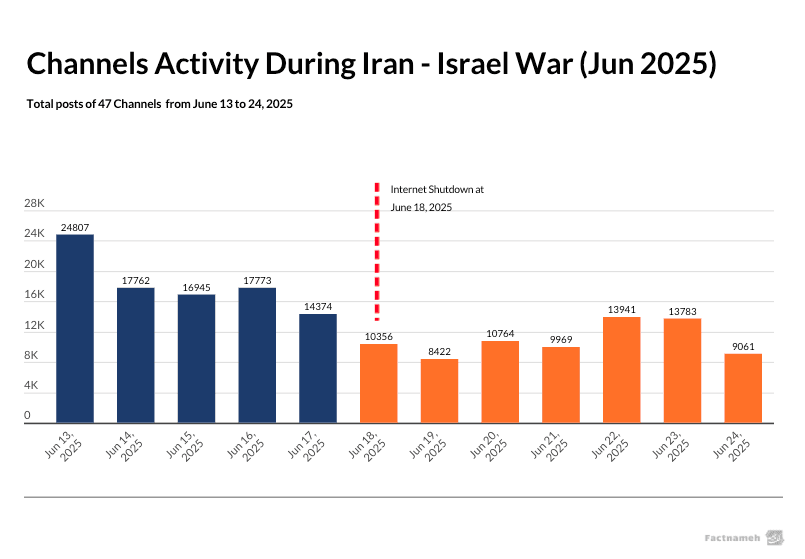
The chart above shows that after the internet shutdown on June 18, the number of posts published decreased somewhat, but definitely not as extreme as the sharp decline observed in January 2026.
Three days before the shutdown (June 15 to 17, 2025), the average number of total posts published by the 48 channels per day was at 16,364. This figure dropped to 9,718 after the shutdown (June 19 to 21, 2025), showing a 40% decrease in activity. Meanwhile, during the recent internet shutdown, the average number of channel posts dropped from 5,578 posts in the three days before the internet shutdown to 600 posts per day after the shutdown– a decrease of 90%.
Another difference is that throughout the June 2025 shutdown period, all of these channels remained active, with the official media and news agencies playing the main role of news reporting and broadcasting the government’s official statements. In contrast, in January 2026, only a limited group of trusted official and unofficial channels affiliated with the IRGC stayed connected to continue broadcasting the authorities’ narrative on the protests and crackdown events.