Foreign Influencers, State Media, and Iran’s Revolution Anniversary: Inside the “Media Tour”
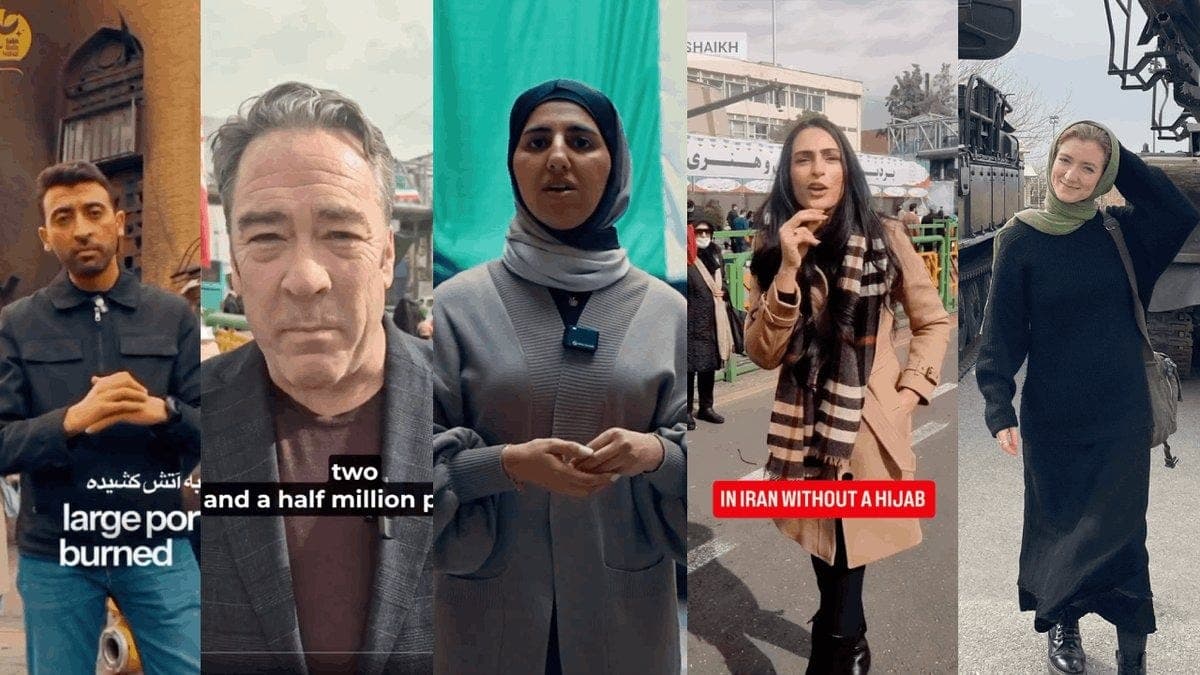
News reports and videos published this year about Iran’s February 11 (22nd of Bahman) anniversary rallies drew significant attention on social media. The annual event, marking the victory of the 1979 revolution, took place roughly a month after the deadly protests across the country, at a moment when demonstrating a large public turnout appeared especially important for the Islamic Republic.
Videos produced by foreign journalists and media figures visiting Iran were repeatedly shared by state media. Many prominent commentators reacted to the image of Iran presented in these reports. Reporting from Tehran, BBC World’s Chief International Correspondent described the February 11 gathering as a “family festival,” while some visiting media activists spoke about women’s freedom in Iran and accused Western countries of demonizing the country.
It was not only accredited journalists who attracted attention, however. This year, several foreign influencers also appeared at the rallies. Some of them walked among pro-government crowds without wearing headscarves, claiming to present a “real image of Iran.”
Nevertheless, a review of reports and media coverage suggests that their presence was less a spontaneous effort to document reality and more the result of a coordinated initiative organized by the Iranian authorities, which could be described as a “February 11 media tour.”
The February 11 media tour — organized by state broadcasting
Media reports indicate that plans for the tour were announced several days before the anniversary events.
The tour appears to have been linked to the Sobh Media Festival, an initiative run by the international division of Iran’s state broadcaster (IRIB) through an organization called the Sobh Media Center. Although the festival’s fourth edition is scheduled for May 2026, organizers appear to have arranged an expedited visit for selected foreign influencers ahead of the February commemorations.
According to the Sobh Media Center, the tour was organized “in response to numerous requests from foreign journalists and media activists seeking to visit Iran and gain first-hand understanding of current events.”
In addition to attending the February 11 rally, participants visited the Islamic Revolutionary Guard Corps’ aerospace missile exhibition the next day and toured parts of cities damaged during the 2025 protests, including burned mosques, museums, and markets.
Reports suggest that the decision to organize the tour was made on January 26, shortly after the violent crackdown on protests earlier that month, and was implemented roughly two weeks later.
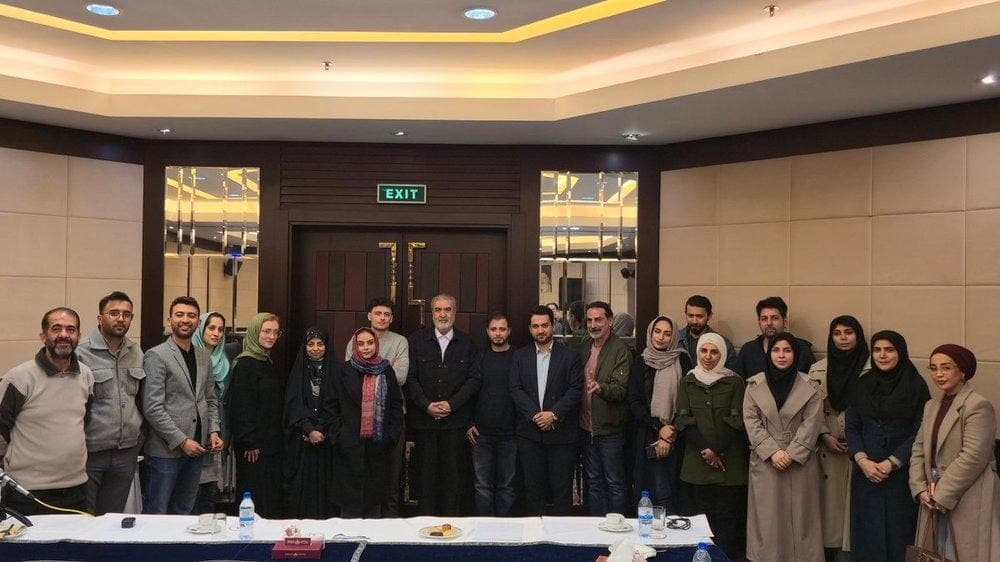
Following their visits, participants published content through Press TV, the festival’s platforms, and their own social media accounts. On February 13, Iranian MP and former Revolutionary Guard member Ebrahim Azizi shared photos of some invited guests on his X account.
Videos of the guests’ arrival in Iran, their airport reception, and guided city tours alongside Press TV journalist Alireza Akbari were also published on the festival’s social media pages.
What is the Sobh Media Festival?
The Sobh Media Center has organized the Sobh Media Festival for the past three years, inviting journalists, filmmakers, media activists, and occasionally politicians to Iran.
The initiative aligns with reforms promoted by IRIB leadership emphasizing criticism of the West, the promotion of Islamic identity, resistance discourse, and efforts to counter positive portrayals of Iran’s former monarchy.
The festival is run by IRIB’s international division, headed since 2021 by Ahmad Noroozi, who was sanctioned by the United States in 2022, in part over the broadcasting of forced confessions.
Although the festival’s funding sources are not publicly disclosed, it is likely financed largely through IRIB’s state budget.
According to organizers, the festival aims to promote media content challenging what Iranian authorities describe as ‘dominant Western narratives’. Earlier editions were attended primarily by regional or pro-Iranian media outlets.
The fourth edition, scheduled for May 2026, will focus on “Media and the New World Order,” with themes including local identity, spirituality, family values, resistance discourse, and anti-imperialism. Approximately 30 prizes ranging from €1,000 to €5,000 are expected to be awarded across different categories.
Foreign guests of the February 11 tour
While the exact number of invitees is unclear, at least five participants received prominent coverage:
- Patrick Henningsen, an American journalist
- Bushra Shaikh, a British-Pakistani media activist
- Calla Walsh, an American political activist
- ElWethek Belleh Chekir, a Tunisian journalist
- Hawrâa Hellany, a Lebanese journalist
Patrick Henningsen
Patrick Henningsen describes himself as an American writer, filmmaker, analyst, and founder of the news website 21st Century Wire. His work has appeared on outlets including RT, Al Jazeera, Press TV, and CGTN.
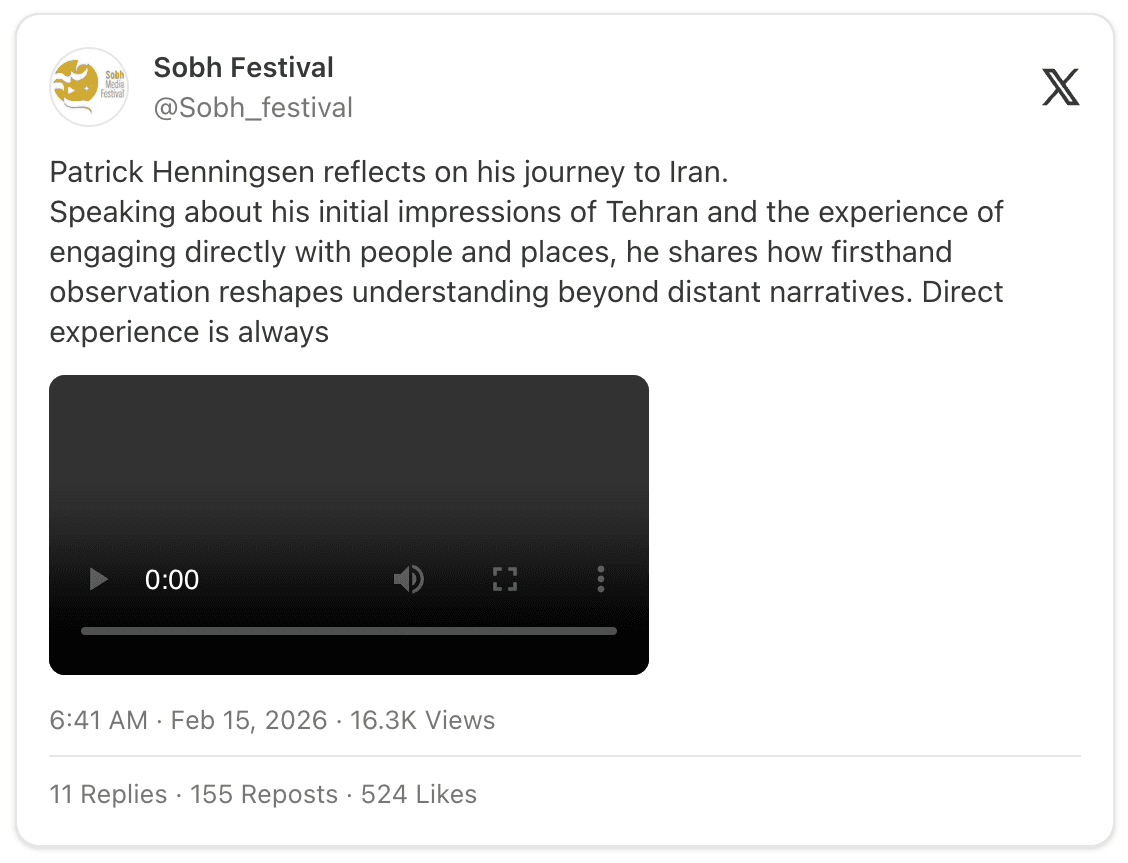
Reporting for Press TV on February 11, he claimed that between two and two-and-a-half million people were present in Tehran by 8 a.m., describing this as evidence of national unity under the Islamic Republic, something he argued Western media deliberately ignores for geopolitical reasons.
During the tour, he also visited IRGC aerospace facilities and praised Iran’s military achievements.
On social media, Henningsen argued that Western propaganda shapes global perceptions of Iran’s leadership and prepares public opinion for possible military action. Based on his observations, he claimed women in Iran are not forced to wear hijab and that Western media promotes stereotypical and negative portrayals of the country.
Henningsen also repeated Iranian government narratives about the January protests, claiming that the CIA and Mossad played roles in unrest, that protesters used violence and human shields, and that the events resembled a coordinated attempt to destabilize Iran ahead of a potential military attack.
Bushra Shaikh
Bushra Shaikh is a London-based British-Pakistani media activist known for her anti-racism advocacy.
Upon arriving in Iran, Shaikh posted videos of herself attending the rally without a headscarf, saying no one warned or confronted her. Much of her content focused on women’s rights in Iran and criticism of Western media portrayals, which she described as propaganda.
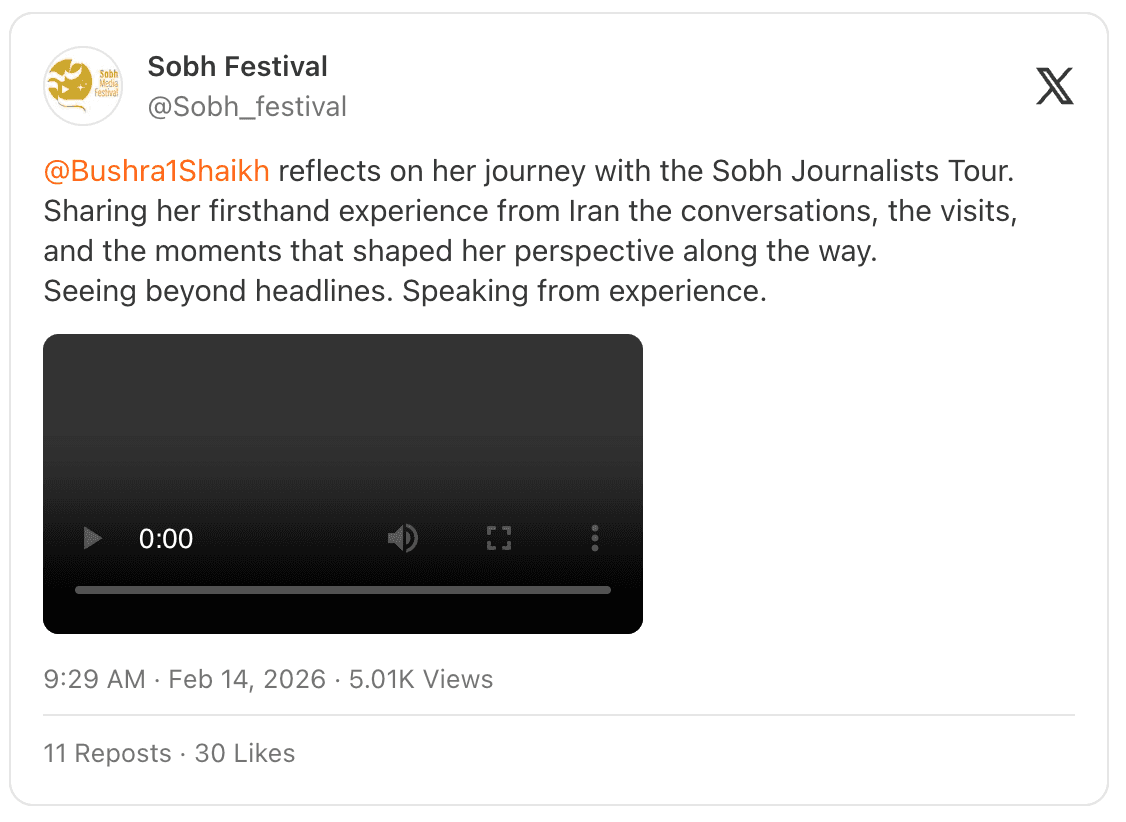
Shaikh said Iranian women told her that diaspora activists and supporters of the former monarchy misrepresent their voices. She also toured markets, protest-damaged areas, and IRGC aerospace exhibitions alongside other participants.
Shaikh repeatedly claimed that security forces were burned alive during protests, assertions not made even by Iranian authorities, and frequently argued that unrest was driven by foreign-backed actors.
Calla Walsh
Calla Walsh is a 22-year-old American political activist focused on issues related to Palestine. Formerly active in the U.S. Democratic Party, she left electoral politics in 2022 over disagreements related to Israel-Palestine policy.
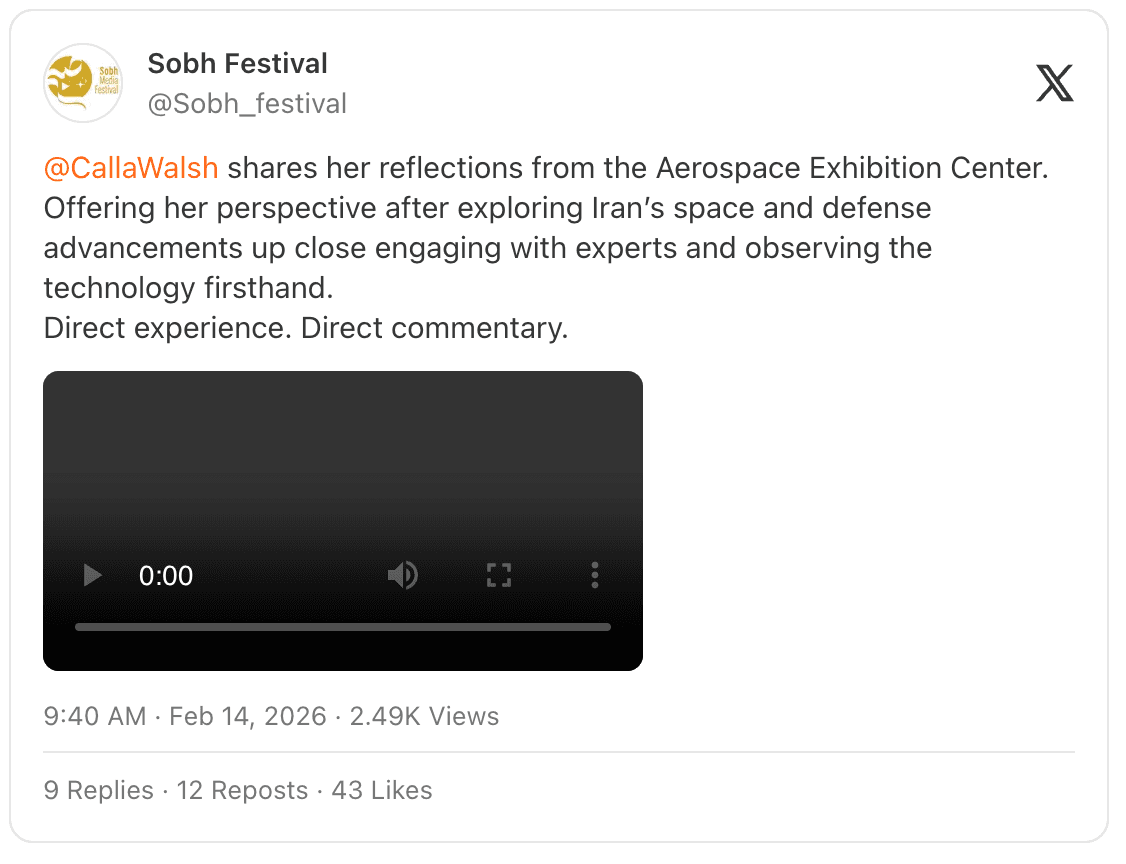
During her stay in Iran, Walsh praised Iran’s military capabilities and repeated official narratives describing the protests as foreign-backed regime-change operations and part of a “hybrid war” against Iran.
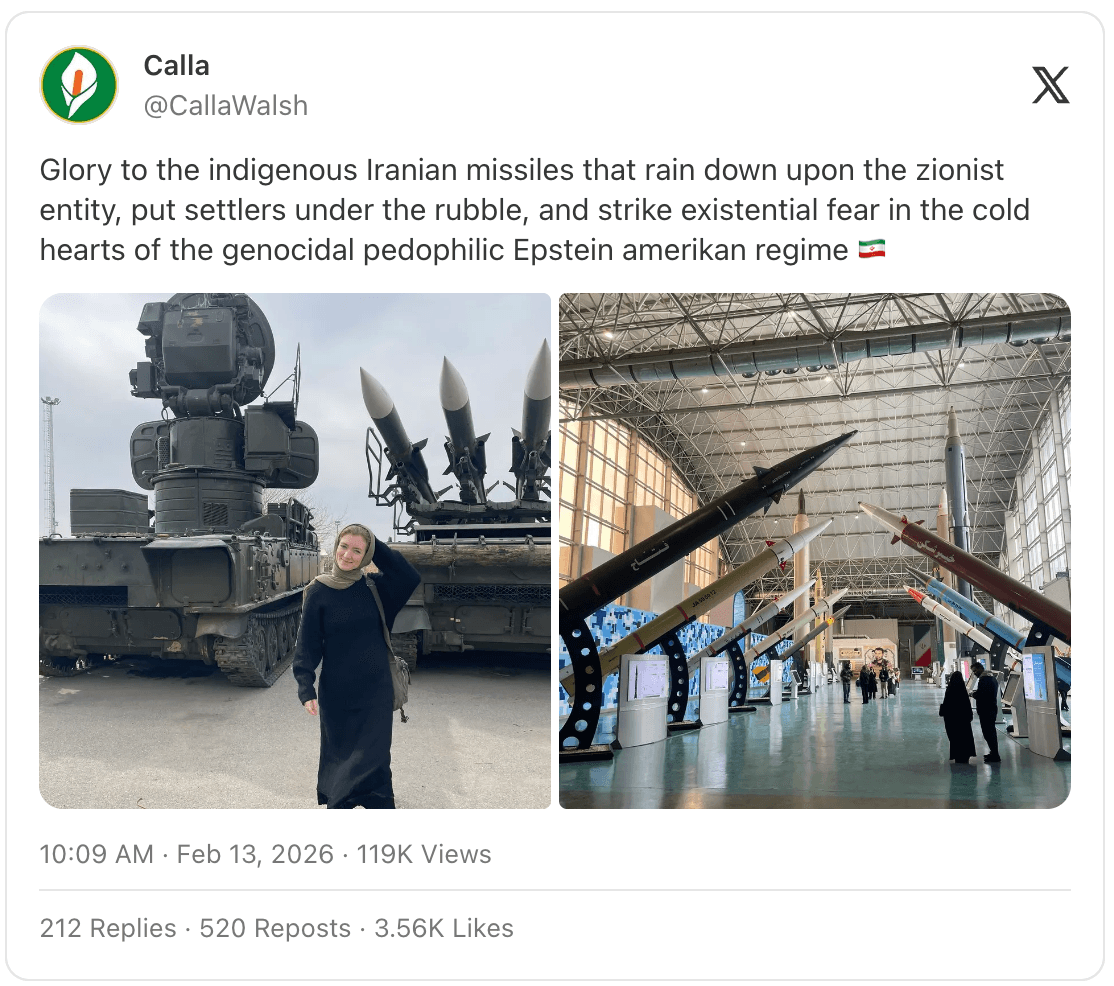
She described Iran as the “most misunderstood country in the world,” accused Western governments of exaggerating casualty figures to justify war, and claimed that millions participated in pro-government rallies ignored by Western media.
Walsh had previously visited Iran through the same festival in 2025 and publicly praised Iran’s missile program during that trip.
ElWethek Belleh Chekir
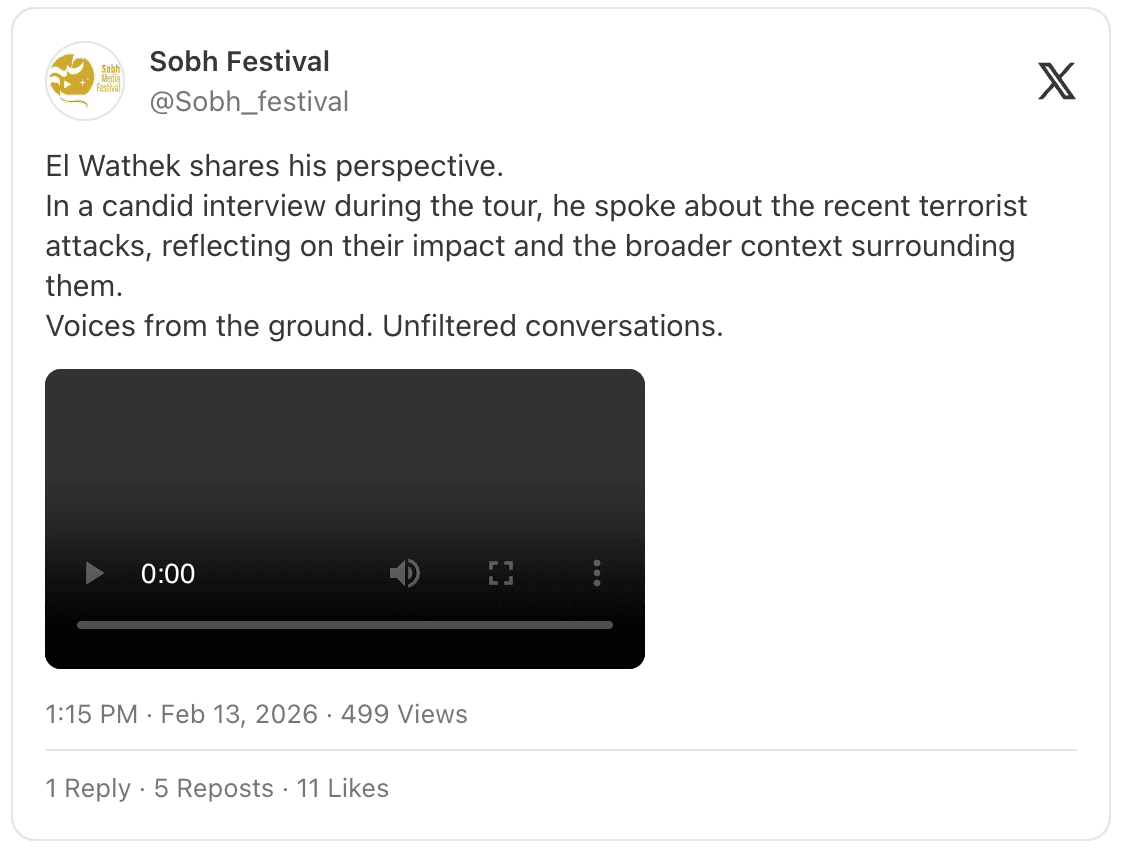
Tunisian journalist ElWethek Belleh Chekir produced video reports from burned mosques and buses shown to visitors during the tour, questioning whether those responsible for attacks were even Iranian.
Hawrâa Hellany
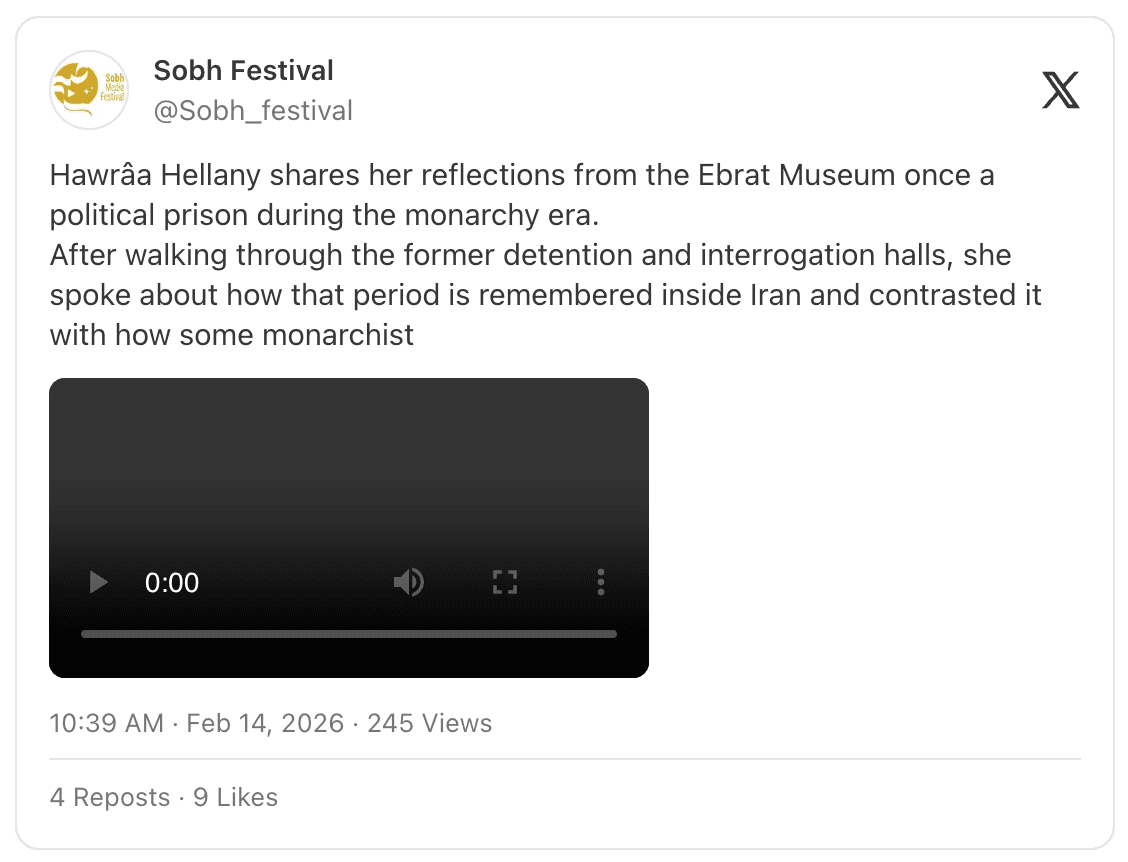
Lebanese journalist Hawrâa Hellany reported from sites such as the Ebrat Museum, which documents torture during the Pahlavi era. In her coverage, Hellany argued that Western countries support movements seeking to turn Iran back into a subordinate state aligned with U.S. and Israeli interests.
Taken together, this media tour appears to be a coordinated propaganda effort aimed at shaping international opinion. By inviting foreign influencers and amplifying their content through state platforms, the Islamic Republic was able to circulate favourable narratives through seemingly independent voices. This year, following a bloody crackdown only weeks earlier, the need for a counter-narrative was especially urgent. Presenting images of unity, normalcy, and popular support served to challenge reports of repression and to recast the state’s response to protests for a global audience. coverage abroad and to recast events inside Iran through sympathetic external voices at a moment when its global image faced renewed pressure.