Information Manipulation During the Early Days of the War
Since the United States and Israel launched coordinated military strikes against the Islamic Republic on 28 February 2026, the region has entered its most serious confrontation in decades. Amid these developments, Persian-language social media and state news were flooded with AI-generated content and unverified claims. Factnameh has been tracking and analyzing these narratives, verifying what can be confirmed and documenting false or fabricated content circulating online.
Islamic Republic’s Narratives in the Early Days of War:
Iran has framed multiple incidents as a deliberate attack on civilian infrastructure resulting in civilian casualties. While reporting on these incidents, state sources have omitted references to the proximity of these sites to security, intelligence, and military compounds.
In the aftermath of his assassination, state media are pushing a narrative that Ali Khomenei was aware of the impending attack, leveraging the narrative of martyrdom.
In an effort to prove its military capabilities, Iran is claiming responsibility for attacks on military facilities and aircrafts, which is contradicted by available evidence and statements from other states (e.g., Kuwait shooting down a U.S. aircraft).
The Islamic Republic attempts to project an image of stability to the international community. In February, they hosted an organized curated tour for foreign journalists, aimed at amplifying the state’s narrative. The same individuals continue translating the established state narratives about the war and political situation in the country.
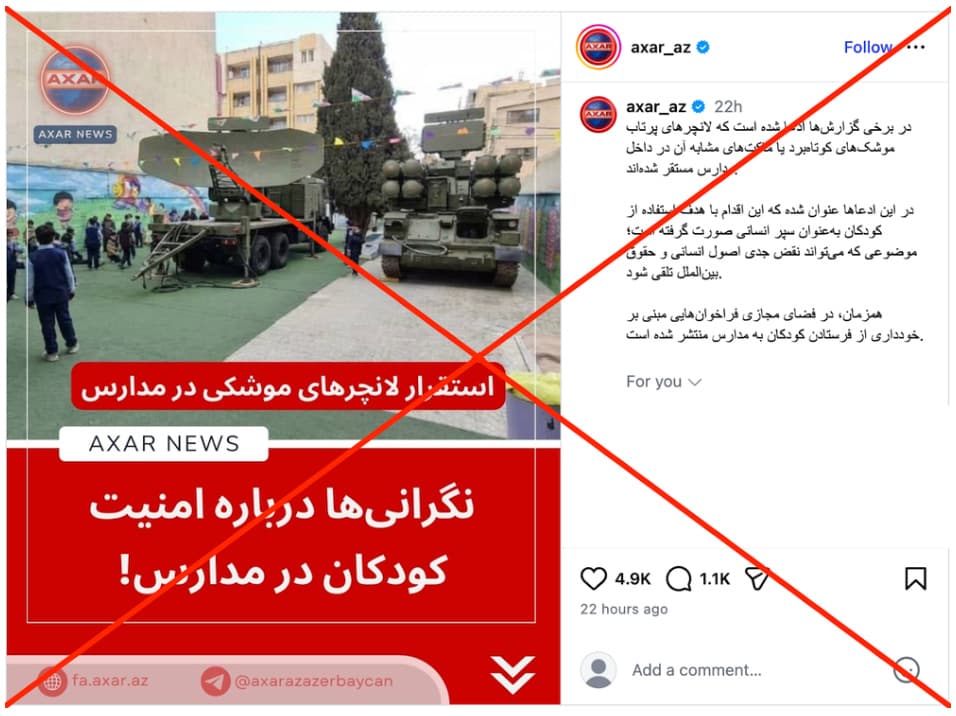
At the same time, AI-generated videos and images are being widely circulated. The Tehran Times (an English-language journal) has published a substantial volume of AI-generated content. Some published images depict alleged highly sophisticated military equipment in primary schools, while others present fabricated evidence claiming that Khomeini’s body was recovered from the rubble.
The Assassination of Ali Khamenei, Supreme Leader of the Islamic Republic of Iran
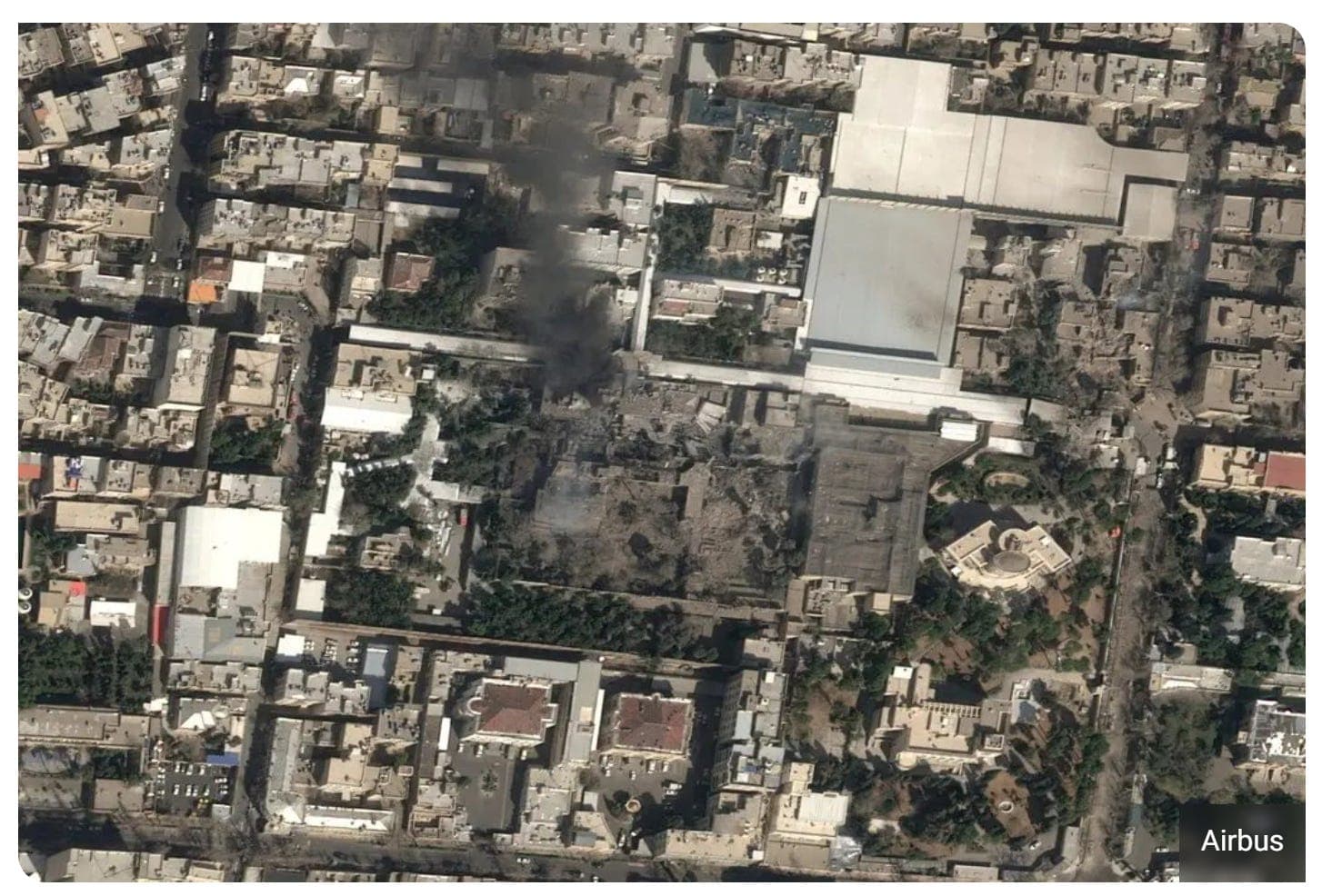
Supreme Leader’s compound in Tehran’s Pasteur district, known as Beit-e Rahbari.
How was Khamenei Killed?
Ali Khamenei, the Islamic Republic’s Supreme Leader and highest political and religious authority, was killed on the morning of 28 February 2026 during the first wave of a joint U.S.–Israeli military operation. The strike targeted the leadership compound in Tehran’s Pasteur district, known as Beit-e Rahbari. The New York Times reported that U.S. intelligence had learned in advance that a meeting of Iran’s Supreme National Defense Council would take place there that morning and concluded that senior military officials and Khamenei would be present. That information led U.S. and Israeli military officials to shift the operation from nighttime to the morning so the strike could coincide with their gathering, and missiles were launched with timing aligned to the council session. A detailed technical analysis of the operation is available in English here.
What Happens Under Iran’s Constitution if the Supreme Leader Dies?
Under Articles 107 and 111 of Iran’s Constitution, if the Supreme Leader dies, resigns, or is deemed incapable, the Assembly of Experts is responsible for selecting a new Leader.
Until a successor is appointed, leadership duties are carried out by a temporary council consisting of the President (Pezeshkian), the Head of the Judiciary (Mohseni Ejei), and a Guardian Council jurist chosen by the Expediency Council.
https://x.com/factnameh/status/2027842336416305423
Ali Khamenei on Factnameh: 49 Fact-Checks
Ali Khamenei’s profile on Factnameh includes 49 fact-checking articles examining statements attributed to him or claims related to his record and positions.
Of these, 19 were rated “False,” 13 were classified as “Outrageous,” and 11 were found to be “Misleading.” Two were rated “Half-True,” four were rated “True,” and none were categorized as “Unverifiable.”
https://x.com/factnameh/status/2027938327299502333
AI-Generated Fabrications
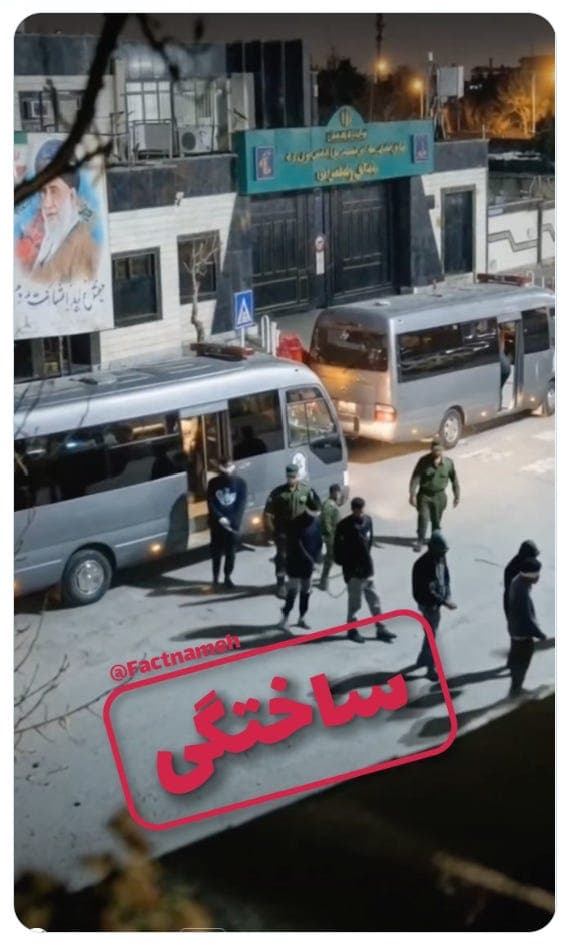
Video falsely claims prisoner transfers from Evin
AI-Generated content
A video circulating online alleges that prisoners are being moved from Evin Prison to Islamic Revolutionary Guard Corps bases for use as human shields. The claim is unsupported. The footage shows multiple markers of AI production, including nonsensical on-screen text, meaningless road signage, and a synthetic, computer-generated narration. At present, there is no confirmed information about prisoner transfers or about conditions inside Iran’s prisons.
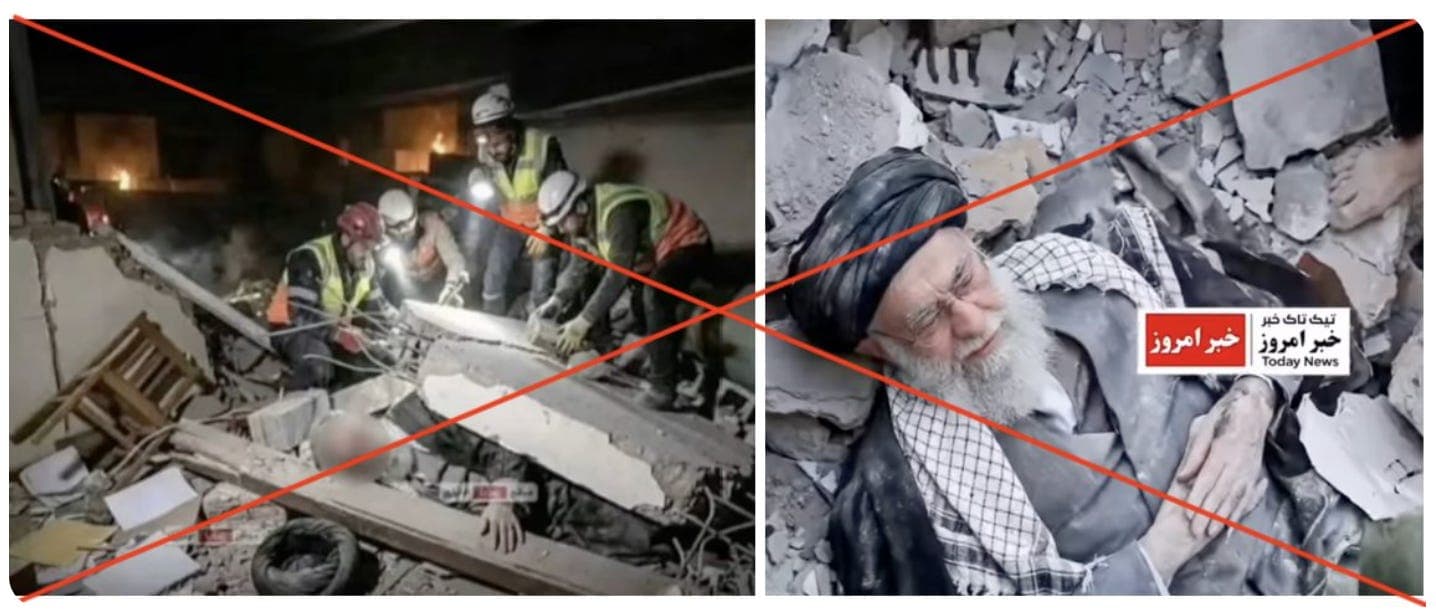
Images falsely claim to show Khamenei’s body being recovered from rubble
AI-Generated content
On 1 March 2026, images circulated widely on social media claiming to show the moment Ali Khamenei’s body was pulled from the rubble following the joint U.S.–Israeli airstrikes. At least two different images were shared: one depicting rescue workers lifting a body from beneath concrete debris, and another showing him in a half-seated posture amid the ruins. No credible domestic or international source has published verified photographs of debris removal at the leadership compound or the recovery of his body. Both images are AI-generated. Visual inconsistencies — including unnatural body positioning, duplicated limbs, an undamaged pair of glasses, and misplaced rescue equipment — indicate digital fabrication.
AI-Generated content
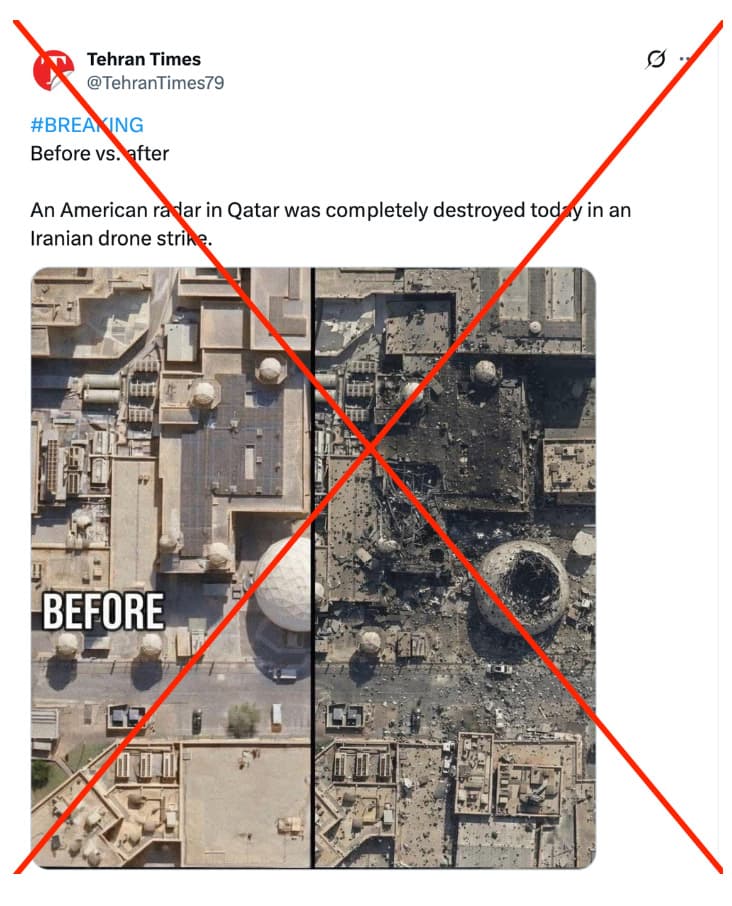
An aerial photo shared by the Twitter account “Tehran Times” claims to show a U.S. radar in Qatar destroyed in an Iranian drone strike. The image is not authentic. Analysis shows it is AI-generated and based on a Google Earth image dated 2 September 2025. Key visual details, including vehicles appearing in identical positions across supposed “before” and “after” views, indicate manipulation. Additional elements visible in the alleged post-strike image do not appear in the original satellite photo. The location itself is misidentified: the site shown is the U.S. Navy’s Fifth Fleet headquarters in Manama, Bahrain, not Qatar or Al Udeid Air Base. The image circulating as evidence of the radar’s destruction is fabricated.
Images claiming military equipment at a primary school in Shahin Shahr is fabricated
AI-Generated content
An image circulated on social media claiming to show heavy military equipment parked inside the courtyard of Karimian Primary School in Shahin Shahr, Isfahan. The claim is false. Analysis shows the vehicles were digitally added and the image was manipulated. In uncropped versions of the picture, a four-pointed star watermark associated with Google’s Gemini AI model is visible in the lower corner, indicating that the image was generated or edited using artificial intelligence. The military vehicles depicted, including what appears to be a Tor-M1 air defense system and a mobile radar unit, are too large to enter a school courtyard without structural damage, given the standard height limits for school entrances. The school itself publicly denied the claim and shared video from its courtyard showing no such equipment.
Videos falsely presented as Iran’s military power
AI-Generated content
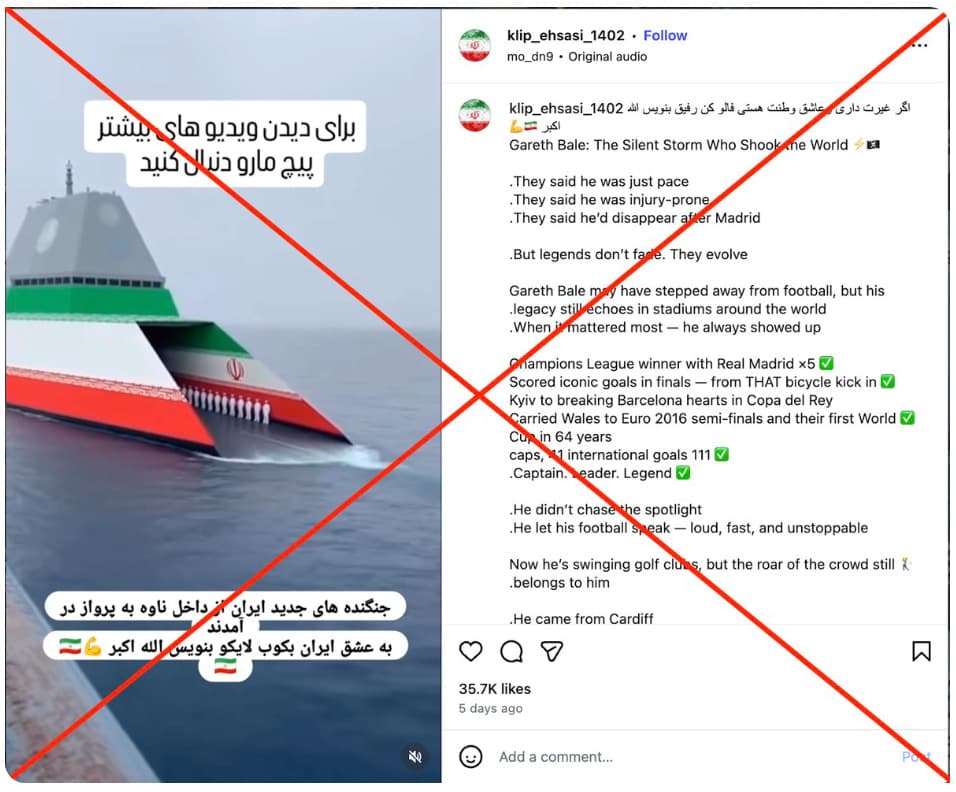
In the days preceding the escalation of tensions, and amid speculation about possible U.S. military action against Iran, videos circulated on Instagram purporting to show advanced military equipment of the Islamic Republic. The clips, often set to dramatic music, depict scenes such as fighter jets inside aircraft carriers, missile transport trucks, ballistic missile launches, and drone patrols over the Persian Gulf. Captions describe them as evidence of Iran’s missile strength or combat readiness. However, these claims are false. The videos are AI-generated and do not show real military operations or equipment.
Video of the aircraft carrier Gerald Ford being moved on land
AI-Generated content
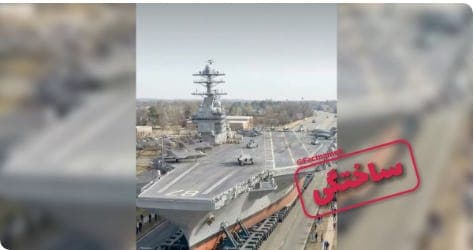
On 26 February 2026, a video circulated on social media claiming to show the U.S. aircraft carrier USS Gerald Ford being transported overland by trucks on a highway. The video is not real. It was first uploaded on 1 January by an English-language YouTube channel using the hashtag “aiaircarrier,” clearly indicating it was AI-generated. The narration in the original video does not claim the footage is authentic and instead says that if the carrier were ever moved on land, a Volvo Iron Knight truck could theoretically do it. Volvo Iron Knight, however, is a speed-record demonstration truck and is not designed to haul cargo. Visual inconsistencies in the footage, including traffic patterns and lane use, further indicate fabrication. The video showing the aircraft carrier being transported by truck is false.
Misattributed, Recycled, or Misinterpreted Content
False claim about Iranian air defenses confronting an F-35 in Bandar Abbas
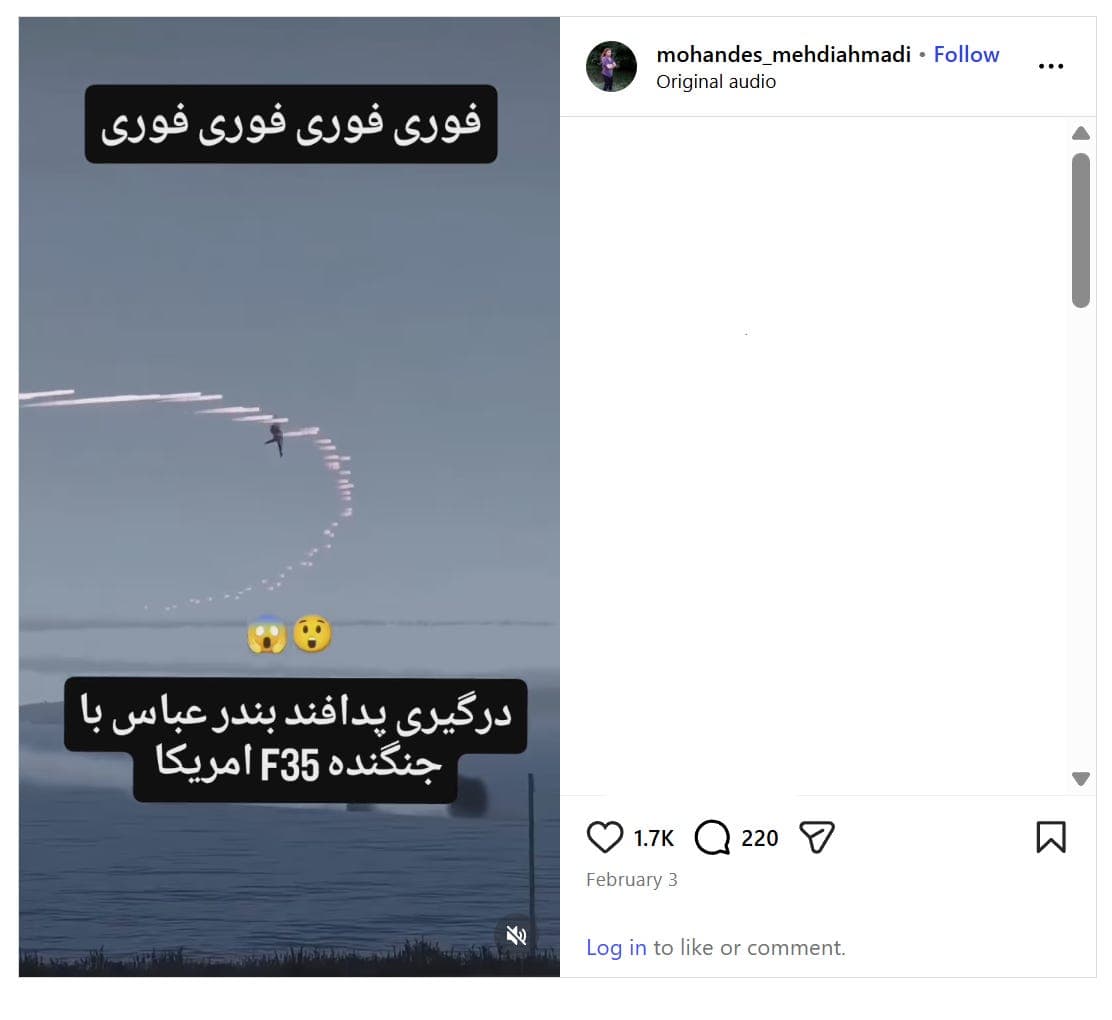
A video widely shared on social media claims to show Iranian air defenses confronting an F-35 fighter jet in Bandar Abbas. Factnameh’s review found that the footage is not real. The scenes come from the video game Arma 3, a military simulation known for its realistic battle scenarios. Similar clips from this game have previously been misrepresented as real conflicts in Ukraine and Gaza.
What do we know about the “jet” sounds heard over Iran?
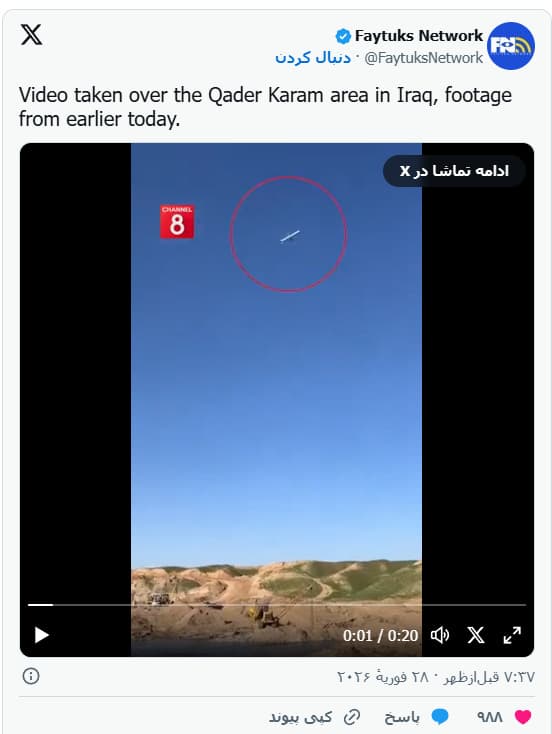
On 28 February 2026, social media users reported hearing the sound of low-flying fighter jets over parts of Iran. However, the videos examined in this review did not show any U.S. or Israeli aircraft. In one case, the aircraft visible was identified as an Iranian Air Force MiG-29. Most of the sounds captured in the reviewed audio and video clips are consistent with BGM-109 Tomahawk cruise missiles, which use a turbofan engine and fly at very low altitude. Tomahawks are designed to travel close to the ground to allow their terrain-matching guidance systems to function accurately and to reduce radar detection. The reviewed videos do not provide evidence of U.S. or Israeli fighter jets operating over Iran.
Video of missile strike on school in Minab misattributed to Pakistan
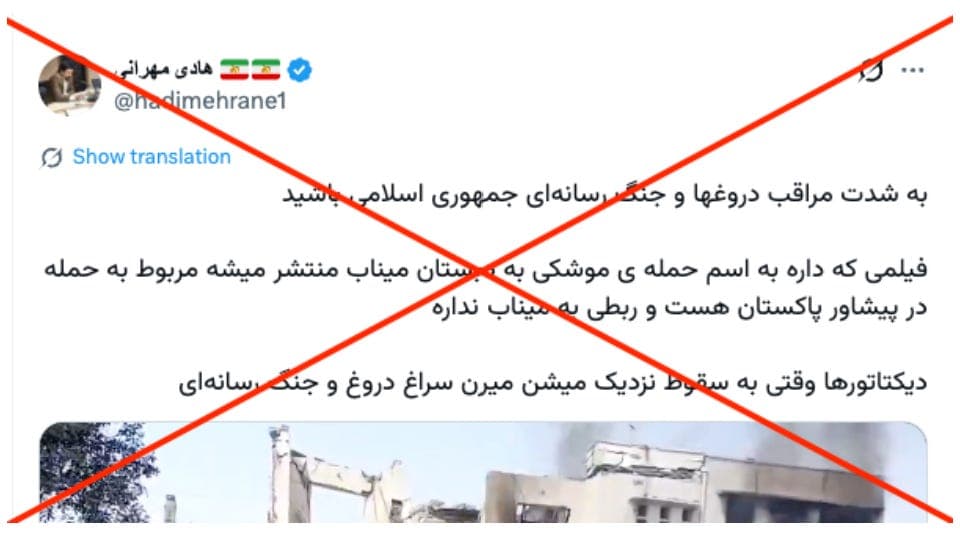
In the early hours of the joint U.S.–Israeli strikes on 28 February 2026, footage circulated showing a missile hitting a girls’ school in Minab, Iran. Soon after, claims spread on social media that the video was actually from Peshawar, Pakistan, and not Iran. This claim is false. Visual markers in the footage, including the flag of the Islamic Republic displayed on the school building, match verified images of the girls’ school in Minab. The video was recorded in Iran, and the attribution to Pakistan is incorrect.
The U.S. Department of War officially announced it is in a state of war readiness
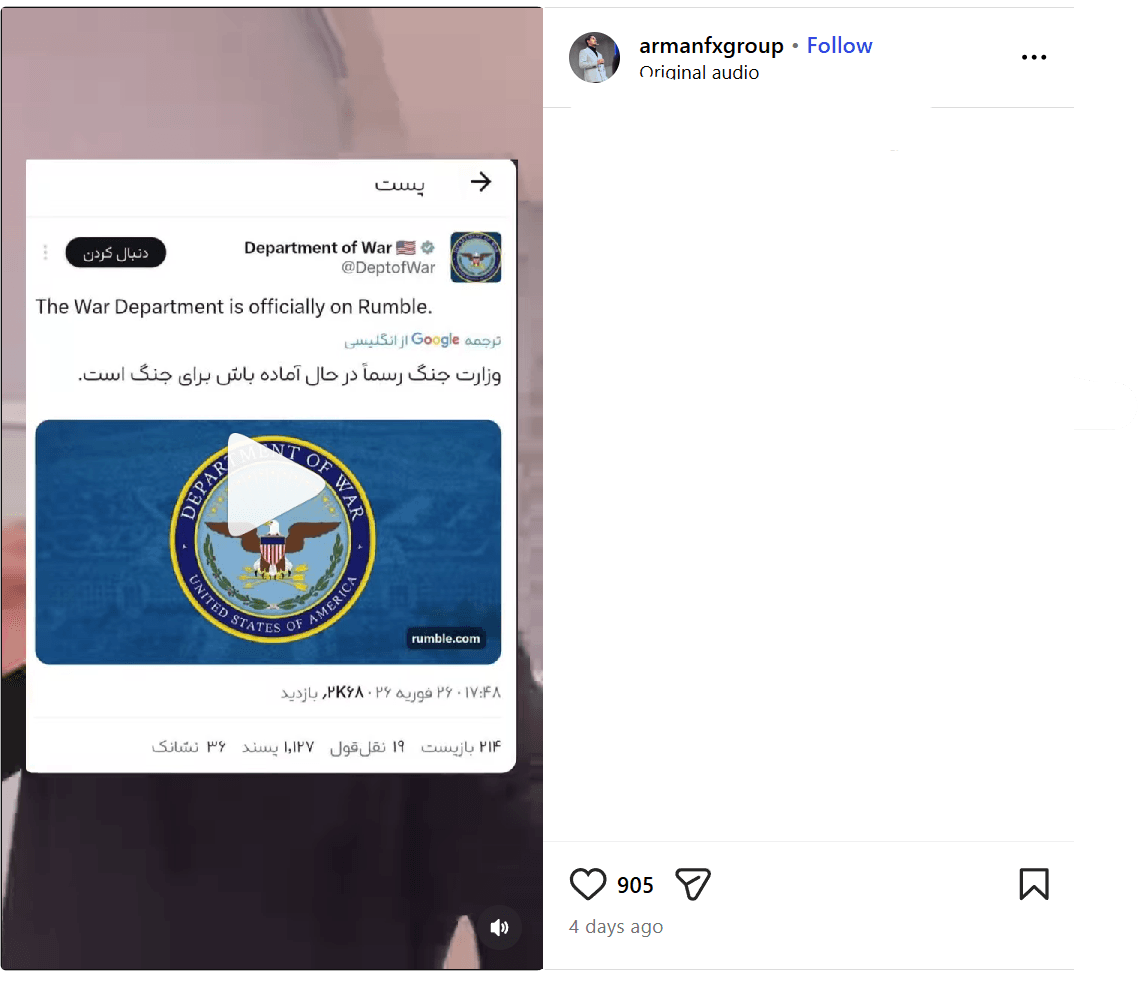
On 27 February 2026, a claim circulated on social media stating that the U.S. “War Department” had officially announced it was on war alert. The claim is based on a screenshot of a post on X that read, “The War Department is officially on Rumble.” The post refers to the launch of an account on the video-sharing platform Rumble, not a declaration of military readiness. The word “Rumble” in this context is the name of a platform and does not indicate combat status or mobilization. The translation shared online misrepresented the original message. Some accounts, including pages focused on financial markets, amplified the mistranslation while promoting trading signals. The claim that the United States officially declared war readiness is false.
Ongoing Monitoring and Analysis
Factnameh continues to monitor and analyze state and non-state information manipulation to shape narratives and high-engagement content circulating in Persian-language online spaces.