An Analysis of Iran’s Telegram News Channels During the First 72 Hours of the War

The Islamic Republic shut down the Internet shortly after the US-Israel strikes started on the morning of February 28, 2026. During the internet shutdown in early January, after the deadly crackdown of mass protests in Iran, only a select number of Telegram channels among the top 50 remained online and active. Paralleling state’s initial unpreparedness and lack of centralized messaging to shape the narrative both at home and abroad.
During the first 72 hours of the war, despite the Islamic Republic’s immediate shutdown of the internet following the US-Israel strikes on the morning of February 28, 2026, all 50 analyzed pro-state Telegram channels remained active and reported with a unified message. This contrasts with the previous internet shutdown in early January, where only a few of the top 50 channels stayed online, reflecting the state’s initial lack of a coordinated message during that earlier crisis.
The centralized message pushed across these 50 channels was clear: Continuing the war and responding to the attacks carried out by the United States and Israel.
Analysis of the 44,615 text posts from this period strongly indicates a state-orchestrated narrative. The posts show a high degree of similarity: more than two-thirds (65.1%) had a word-similarity rate above 95 percent, where similarity is defined by the use of highly identical vocabulary in posts.
This coordinated content demonstrates that the state was prepared from the onset of the war to control the online narrative. It aligns with the Islamic Republic’s established strategy of maintaining control over domestic and international narratives during internet shutdowns by selectively granting internet access to specific entities and individuals. While all 50 channels support the Islamic Republic and oppose the United States and Israel, their specific approaches and tones in coverage typically vary.
The unofficial network linked to the IRGC operates in a more aggressive style and focuses mainly on the war and Iran’s attacks. These channels often exaggerate reports of Iranian missile “hits” on Israel and on U.S. bases in the region. The other groups also report Iranian missile attacks and often exaggerate reports of successful missile “hits.” At the same time, they publish news about attacks inside Iran and report on the damage caused by foreign strikes.
What stands out in this early analysis is that news of Khamenei’s death does not appear to be a top priority compared with coverage of the war. Keywords related to the leader appear far less frequently than terms linked to the IRGC or Iranian missile attacks. Between the first reports of Khamenei’s death in international media and the official confirmation by state television, the channels avoid confirming the news. Posting activity drops noticeably, and many posts claim the Supreme Leader is alive and reports of his death are false.
Under Articles 107 and 111 of Iran’s Constitution, if the Supreme Leader dies, resigns, or is deemed incapable, the Assembly of Experts is responsible for selecting a new Leader. Until a successor is appointed, leadership duties are carried out by a temporary council consisting of the President (Pezeshkian), the Head of the Judiciary (Mohseni Ejei), and a Guardian Council jurist chosen by the Expediency Council. Alireza Arafi was selected as the jurist.
Reports about the Supreme Leader’s succession also remain marginal compared with war coverage. Keywords such as “Arafi,” “Khomeini,” “Assembly of Experts,” and “succession” appear far less often than war-related terms such as “hit,” “drone,” and similar expressions.
For decades, Ali Khamenei’s name dominated official news in the Islamic Republic. His speeches and statements usually occupied the most prominent position on newspaper front pages and news websites.
Yet after his death, something unusual happened.
In the Telegram news ecosystem inside Iran, Khamenei quickly faded from the center of attention. Persian keywords such as “[The] leadership,” “Khamenei,” or “martyrdom” appeared far less frequently than words like “missile,” “attack,” “strike,” “drone,” and “IRGC.”
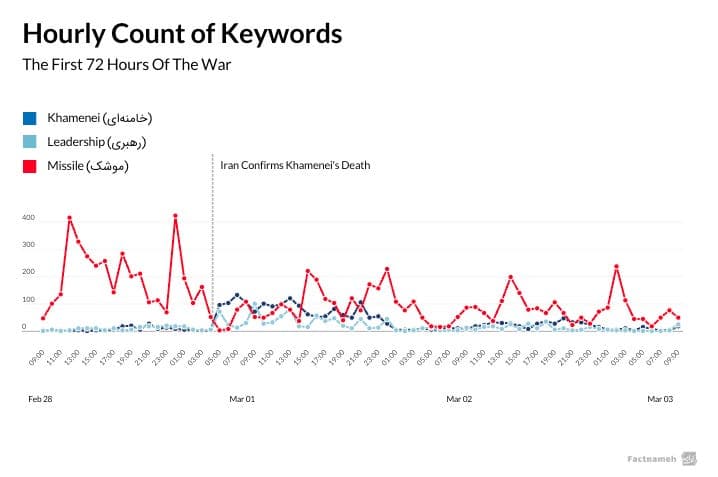
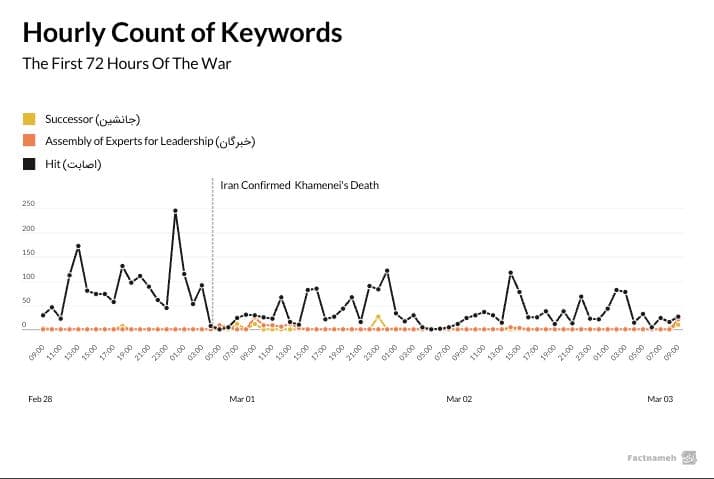
Even discussions about who might replace him received little attention. Terms such as “successor,” “Assembly of Experts,” or the names of potential candidates like Alireza Arafi or Hassan Khomeini appeared far less often than military-related keywords.
What was clear, the question of leadership was not the system’s top messaging priority at the time. The state and aligned media networks appeared to focus on something else: continuing the war and responding to the attacks carried out by the United States and Israel.
At the time of writing, the future leadership of the Islamic Republic remains uncertain.
Early hours of the war
At 9:42 a.m. local time on February 28th, 2026, a short message appeared on the Telegram channel Jamaran News. It reported a powerful explosion in Tehran. Within seconds, news channels inside and outside Iran began sharing a similar message that massive explosions had struck the capital. Reports quickly pointed to a much bigger development. The United States and Israel had launched aerial strikes on Iran, and one of the targets appeared to be the residence of Supreme Leader Ali Khamenei.
Early reports suggested that the compound known as the Beit-e-Rahbari had been struck. Several hours later, it became clear that Ali Khamenei had been killed in the first moments of the attack. Yet inside Iran’s Telegram news network there was no mention of this possibility. The channels reported explosions, missile strikes, and military developments, but the fate of the country’s leader remained unspoken.
By late afternoon, rumors of Khamenei’s death began circulating across international media. Inside Iran, however, almost no channel repeated the claim.
The silence continued for hours.
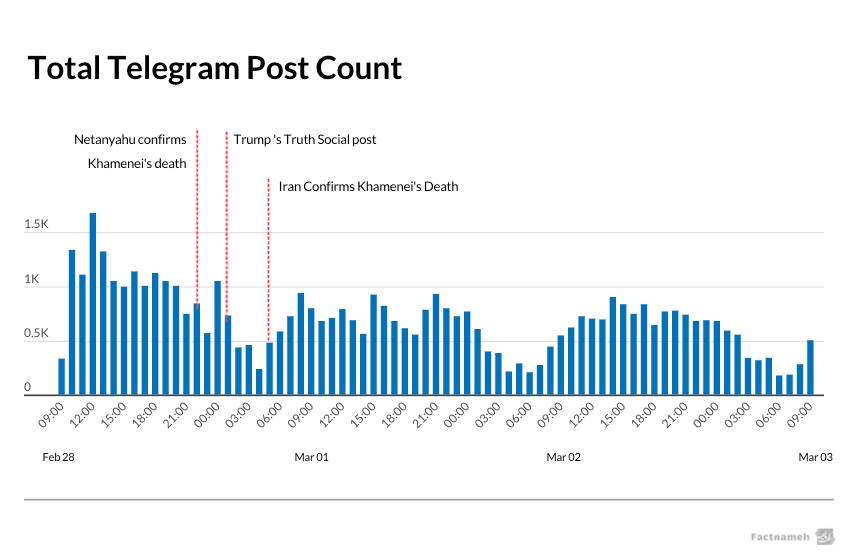
At 10 p.m. Tehran time, Israeli Prime Minister Benjamin Netanyahu indirectly confirmed the news. Shortly afterward, U.S. President Donald Trump told NBC that “we believe the reports of Khamenei’s death are accurate.” Even then, Iranian Telegram channels avoided the topic. No one appeared willing to confirm such a historic event.
The hesitation became visible in the data. Between the evening of February 28th, and the early hours of the next day, activity across Iranian Telegram news channels dropped noticeably. Many channels simply slowed down or stopped posting.
Finally, at 5 a.m. local time on March 1st, Iran’s state broadcaster confirmed the news. It announced that Ali Khamenei, the former leader of the Islamic Republic, had been killed 19 hours earlier during the initial attacks.
Analyzing Telegram activity during the first 72 hours
In this report, we are analyzing 50,000 Telegram posts from the top 50 news channels with the highest number of subscribers and engagement rate operating inside Iran. We have categorized these channels into four groups:
- An unofficial network linked to the Islamic Revolutionary Guard Corps (IRGC) and other security institutions;
- Official media outlets affiliated with the government and state institutions;
- News websites aligned with different political factions;
- Highly active “breaking news” channels that focus on rapidly reposting news content.
The dataset includes more than 77,000 Telegram posts collected from two days before the attacks until the third day of the conflict. 50,591 posts were published during the first 72 hours, between 09:40 (GMT+3:30) on February 28th and 10:00 (GMT+3:30) on March 2nd, 2026.
Each record includes the channel name, time of publication, post text, and link. The data are available in CSV format. The channels were selected based on TGStat rankings of the most active and most widely viewed news channels inside Iran.
Factnameh previously analyzed this Telegram network during the early January internet shutdown. At that time, only a limited group of channels—many linked directly or indirectly to the Islamic Revolutionary Guard Corps (IRGC) or security institutions—remained active. Even official government media channels were largely silent during the shutdown.
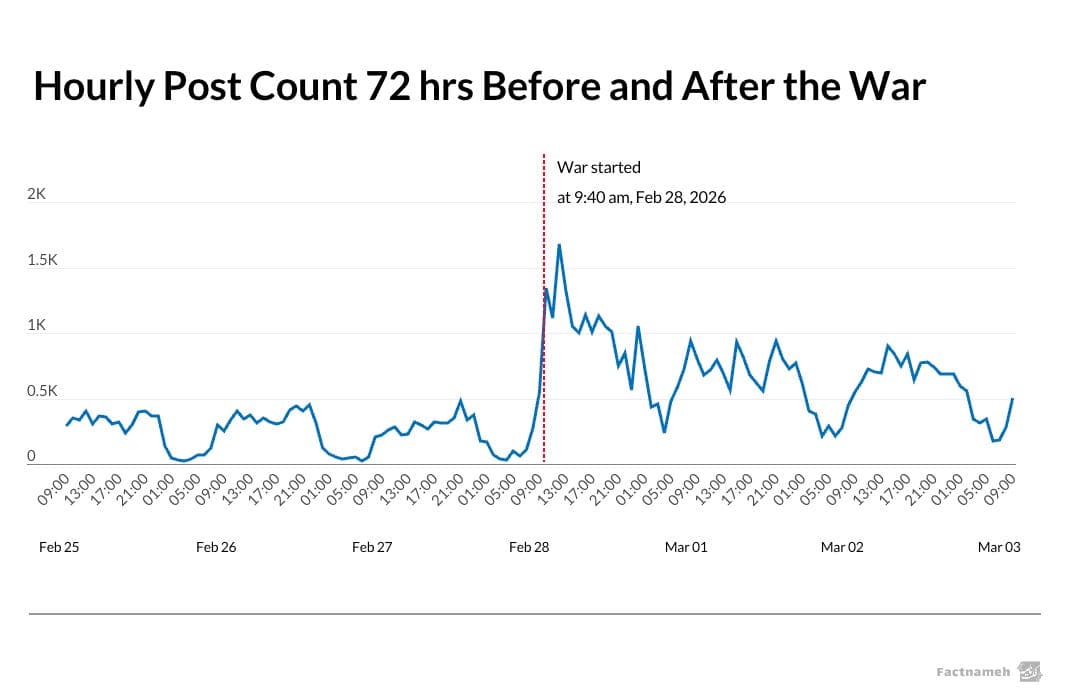
However, the situation during the war was different. Even after internet restrictions were imposed, we observed no interruption in activity. In fact, the channels became more active than before. Content production rose from fewer than 500 posts per hour to roughly 1,000 posts per hour on average.
Telegram channel categories
The 50 channels examined in this report can be broadly divided into four groups.
- Unofficial channels linked to the IRGC or security institutions.
These include channels Sepah, Sepah Cybery, Sepah Quds, Afsaran-e Jang-e Narm, Bisimchi Media, Saberin, Masaf, Defapress, and Nour New:
@sepah, @Afsaran_ir, @sepah_ir, @BisimchiMedia, @sepah_quds, @sepah_pasdaran, @sepahcybery, @sarbazane_g, @SaberinFa, @Saberin_ir, @masaf, @mahdaviatsiasi, @serfan_jahate_ettela, @defapress_ir, @Nournews_ir,
- Official state-affiliated news agencies.
Channels connected to government media organizations such as IRIB News, Mehr News, ISNA, Fars, Tasnim, and Young Journalists Club:
@iribnews, @irnews, @mehrnews, @isna94, @farsna, @Tasnimnews, , @yjcnewschannel, @iribnews_com
- Newspaper and news-website channels.
These include outlets such as Etemad Online, Entakhab, Ham-Mihan, Jamaran, Shargh, Tabnak, Mashregh News, and several others:
@EtemadOnline, @Anapress1, @eco_today, @entekhab_ir, @hammihanonline, @qudsonline, @Asriran_press, @Jarian_com, @jamarannews, @Eslahatnews, @mashreghnews_channel, @khabaronline_ir, @hamshahrinews, @SharghDaily, @BourseNews, @rajanews_com, @farhikhteganonline, @snntv, @tabnak, @pezeshkian_com
- “Breaking news” channels Breaking news news-website.
Highly active channels focused on rapid reposting of news content, including Khabar Fori, Akharin Khabar, Khabar Vije, and similar accounts:
@khabarfarda_ir, @Khabare_vije, @akhbaremovasagh_ir, , @akhbarefori, @khabar_furei, @otaghkhabarl, @akharinkhabar, @irnews
Among all channels analyzed, Khabar Fori, Akharin Khabar, Mehr News, Farhikhtegan, and the channels attributed to the IRGC were the most active during the first 72 hours of the war.
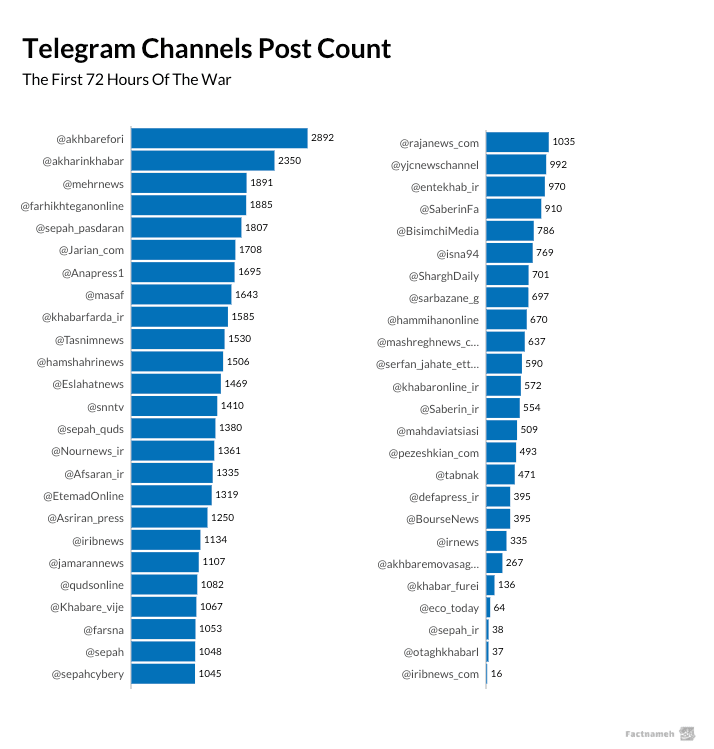
The heavy activity of “Breaking News” channels was expected. Their content typically consists of reposted material from other sources rather than original reporting. What stood out was the strong presence of Mehr News Agency, which is affiliated with the Islamic Development Organization. It was more active than other official agencies linked to the IRGC, such as Tasnim or Fars, and even more active than state outlets like IRNA, ISNA, or the national broadcaster’s news channel.
A similar pattern had appeared during the January 2026 protests, when Mehr News and IRIB News were the most active official channels during the internet shutdown.
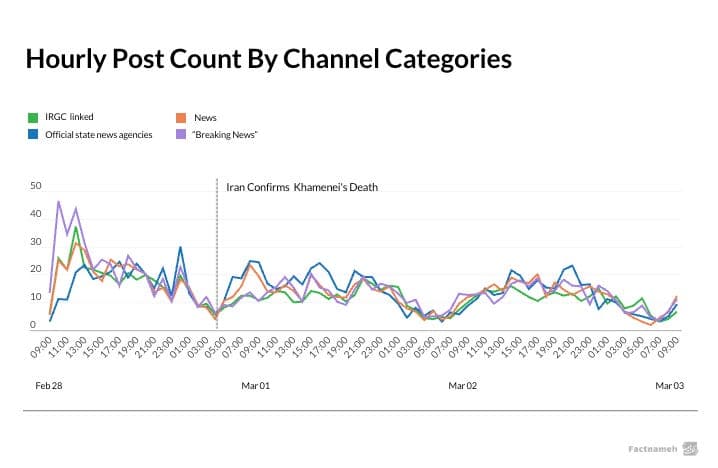
How Telegram activity changed during the first 72 hours of the war.
The data show that “Breaking news” channels dominated the first hours after the attacks began. Their rapid reposting of information allowed them to publish far more frequently than other channels.
As the situation evolved and became more complicated for the Iranian government, official news agencies gradually took the lead in producing content. Other channels increasingly followed their reporting rather than setting the agenda themselves.
What became clear was that reporting across these channels followed a coordinated campaign to push centralized state narrative and messaging. Comparing the words used in the 44,615 text posts during the first 72 hours of the war shows that the similarity rate in more than two-thirds (65.1%) of the posts is above 95 percent. The similarity rate is defined based on the use of similar words in a post. That is, when the words of a post are more than 95 percent similar to the words of another post in the dataset, that post is counted as similar content.
What these channels talked about
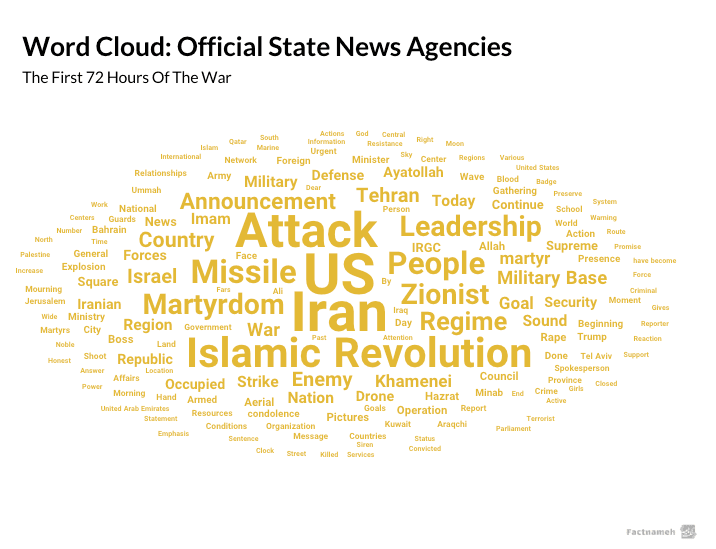
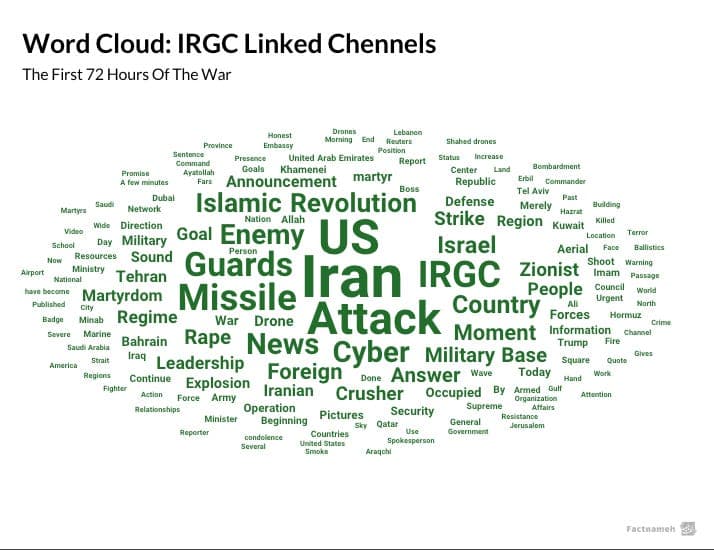
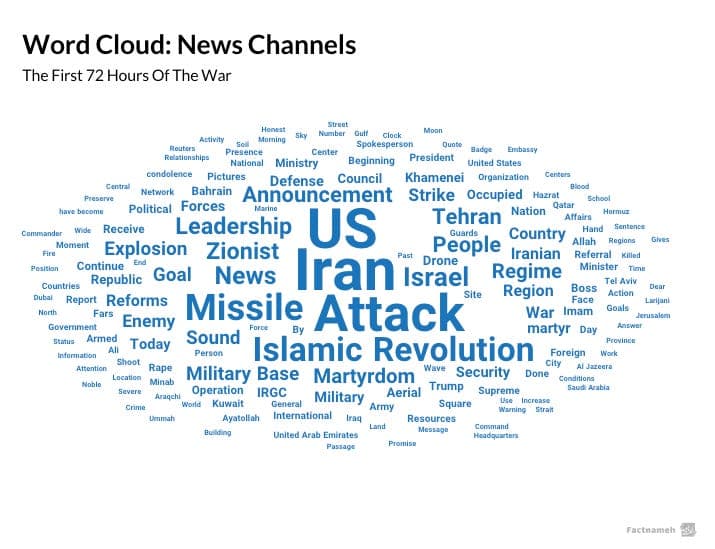
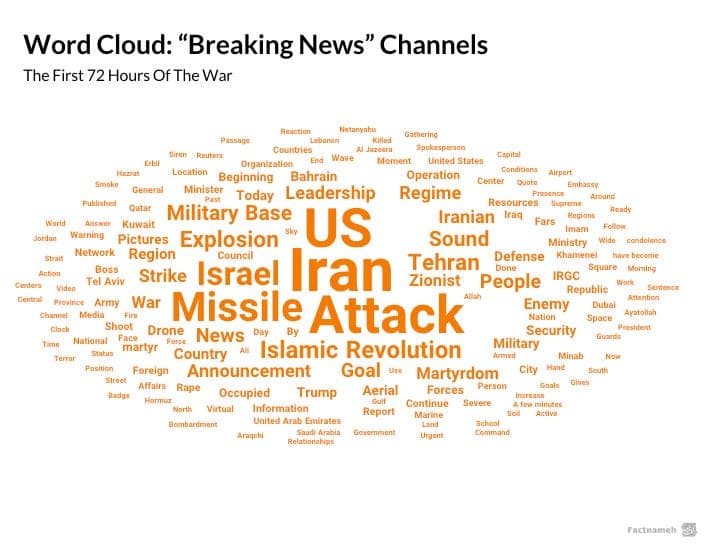
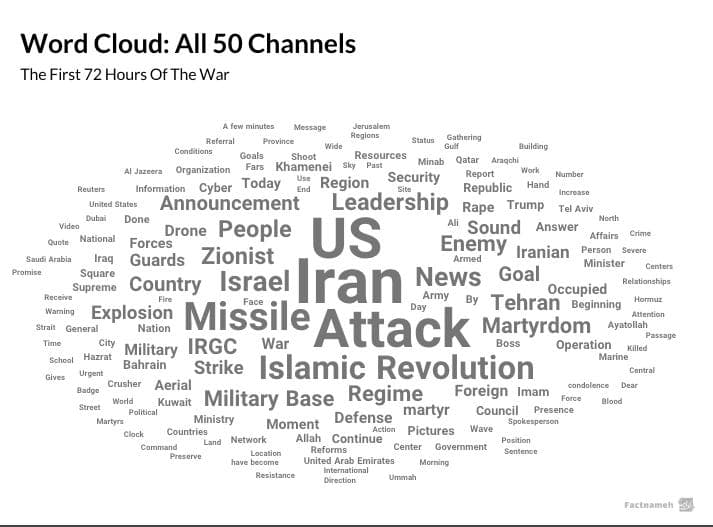
A content analysis of the posts shows that the most frequently used words across the Telegram network were:
“Iran,” “United States,” “Israel,” “Islamic Revolution,” “enemy,” “target,” “attack,” “missile,” and “IRGC.”
These terms (in Persian) appeared more often than words such as “martyrdom,” “leadership,” or references to Khamenei’s death. The coverage focused heavily on military developments, especially Iranian missile strikes.
The tone varied across different types of channels.The unofficial IRGC-linked network was noticeably more aggressive. These channels often exaggerated Iranian missile strikes on Israel and neighboring countries while paying far less attention to the U.S. attacks and their consequences.
Coverage in official news agencies and mainstream news sites was somewhat different. They also emphasized Iranian missile strikes, but at the same time they continued publishing domestic news and internal developments inside Iran.