In Person or Online? The Legal Dilemma Facing Iran’s Assembly of Experts
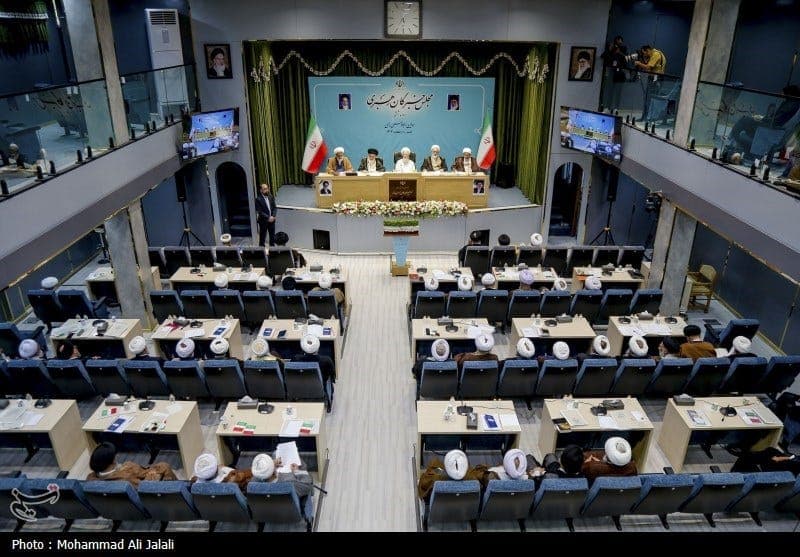
More than a week after Ayatollah Ali Khamenei was killed in joint U.S. and Israeli airstrikes, holding a meeting of the Assembly of Experts to choose a new leader remains a serious challenge and a potential crisis. In the current wartime situation, bringing the key members of the Assembly together in one place is extremely dangerous. The location of such a meeting would likely become a strategic target for further attacks by the United States and Israel. The risk is clear: on March 3, American and Israeli warplanes bombed the Assembly of Experts’ office in the city of Qom.
These unprecedented security threats have created both a legal and practical deadlock in the process of selecting a new leader. On one hand, the danger to members’ lives and the wartime conditions forced the Assembly to hold its first voting session online. For future meetings, they have even considered more hidden locations, such as a building near the shrine of Hazrat Masumeh, to reduce the risk of airstrikes.
On the other hand, the Assembly’s internal rules are based entirely on traditional procedures that assume in-person meetings. This conflict between protecting members’ lives during wartime and following the legal rules raises a basic question: in such a crisis, are members legally required to gather in person despite the risks, or can an online meeting and vote also be considered legally valid?
Legal requirement for physical presence
The current internal rules of the Assembly of Experts are clearly written with in-person meetings in mind. Several legal provisions support this interpretation:
- A specific location: Article 11 of the Assembly’s internal rules states that its meetings are to be held in the city of Qom, unless a necessity requires another location. This suggests that members are expected to gather in person.
- Quorum and voting rules: According to Article 12, a session is official only if two-thirds of all members are present. Article 13 also states that choosing a leader requires the support of two-thirds of those present.
- Physical signatures and traditional procedures: One of the strongest obstacles to an online meeting appears in a note under Article 15. It clearly states that the official record of the leader’s selection must be signed by all members present in the meeting. Other requirements, such as the temporary presiding board going to a special podium, taking an oath at the first session, and using traditional recording tools such as audio tapes and shorthand writers, also suggest that members must be physically present. In addition, Article 107 of Iran’s Constitution requires discussion and consultation among religious scholars before choosing the leader.
Could online participation still be considered “presence”?
One could argue that in today’s world of modern communication, the word “presence” does not necessarily mean being physically in the same room. Audio and video participation could also count as official presence. Today, even court hearings can sometimes be held online.
It could also be argued that the word “necessity” in Article 11 might allow more flexibility in a crisis. In extreme conditions, necessity might justify not only moving the meeting to another city, but also holding it in a virtual space.
Another point is that in modern legal systems, electronic signatures are widely accepted and can replace handwritten signatures when approving official documents.
These arguments are consistent with modern technology and contemporary administrative law. However, they are not explicitly included in the current legal texts. The Assembly’s rules still refer to outdated practices such as audio tapes and shorthand notes, and they do not mention digital identity verification or electronic signatures. Interpreting words like “present” or “signature” too broadly—without clear legal authorization—could raise doubts about the legitimacy of such an important decision.
What is the legal solution?
Despite these obstacles, there is a fully legal path that could make online voting possible. According to Article 108 of the Constitution of the Islamic Republic, after the initial rules of the Assembly of Experts were drafted by the first Guardian Council, any later changes or new regulations related to the Assembly’s duties fall under the authority of the Assembly itself.
This means the members have full independence to amend their own internal rules before the process of choosing a new leader begins. However, changing the rules would still require a physical meeting.
If they do amend the rules, they could create the legal framework for recognizing virtual participation, allowing remote consultations, and using secure electronic signatures. Only after such an internal reform would holding an online meeting have clear legal validity.
For now, based on the laws and regulations discussed above, the Assembly of Experts does not have a clear legal basis to hold the leadership vote online. As things stand, the election would have to be held in person, while following the existing legal procedures.