The “Pink Missile” Campaign: A Case Study in Islamic Republic's State-Sponsored Digital Propaganda
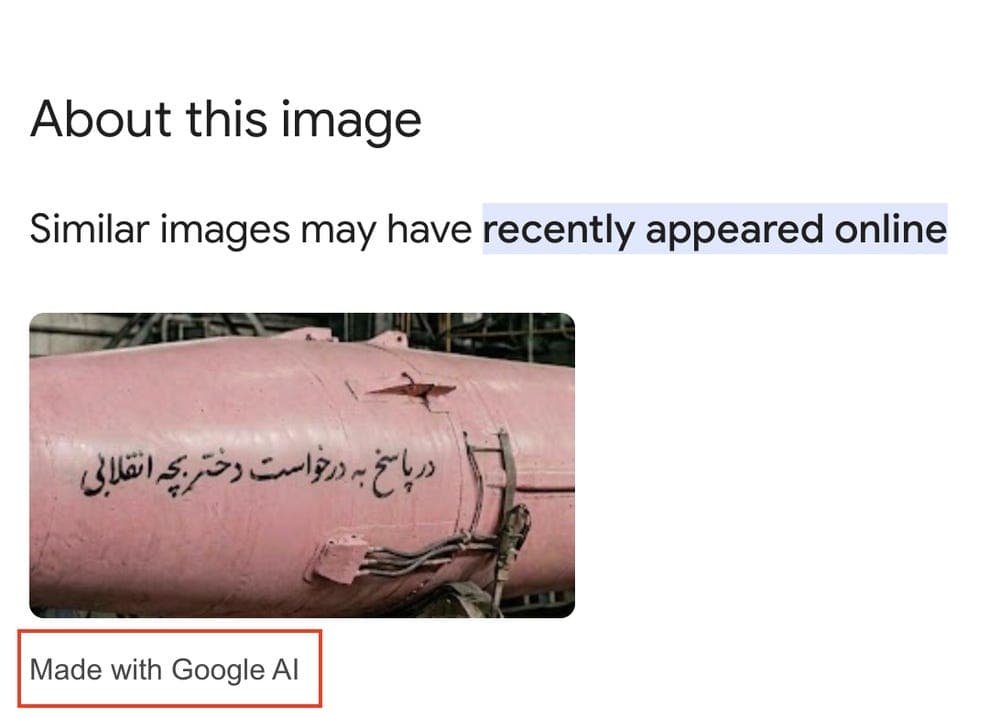
The “Pink Missile” social media campaign, which unfolded last week, serves as a compelling case study in the Islamic Republic’s sophisticated and digitally-driven war propaganda machine. The viral campaign illustrates how state media and affiliated entities with access to the internet leverage social media, emotionally charged narratives, and fabricated content, often generated by artificial intelligence, to rally support and disseminate ideological messages both domestically and internationally.
How Whitelisted Accounts Shape the Narrative During Iran’s Internet Blackout
This sprawling ecosystem of information manipulation to shape narratives is reinforced by the Iranian government’s internet shutdown, now lasting for over a month. The blackout of international internet access severely limits the public’s access to independent and verifiable information, while selected individuals and entities are whitelisted to have unfettered access to the internet. By deliberately cutting off connectivity, the Islamic Republic is isolating the population, making it significantly easier to monopolize the narrative around the war in order to shape public opinion and silence dissenting voices.
The genesis of the “Pink Missile” campaign
On April 4, 2026, around 9.30 PM local time, a clip of a little Iranian girl at the night-time demonstrations in support of the war saying “Seyyed Majid, the pinpoint shooter, flatten Tel Aviv with a pink missile” was published on a Telegram channel with a couple of thousands of followers. It was then quickly picked up and shared by prominent and popular IRGC-affiliated Telegram accounts mentioning that the little girl is asking for a pink missile.
Seyyed Majid Mousavi is the Commander of the Aerospace Force of the Islamic Revolutionary Guard Corps (IRGC), the body responsible for the construction and launch of missiles and drones.
This slogan was a direct derivative of a chant already in common use for the preceding 40 nights of pro-state, pro-war street demonstrations: “Seyyed Majid, the pinpoint shooter, flatten Tel Aviv.” By adding the element of the “pink missile” the chant was instantly transformed from a generic call to military action into a memorable, emotionally charged, and highly shareable social media content.
Within a few hours the clip started to be shared on X. Soon after the @IRhebrew (Iran in Hebrew) account on X shared the clip, acknowledging the little girl’s request and adding “coming soon…” in Persian.
The fabrication and viral spread
Less than 24 hours after the initial clip was published, an AI-generated image of a pink missile with the writing “In response to the request of the revolutionary girl” in Persian was shared on X. Our analysis, using tools like Google’s SynthID technology, confirmed that most or all of the image had been generated or heavily edited with AI.
The @IRhebrew account followed up by sharing the fabricated image saying “mission accomplished” in Persian. This visual content was quickly picked up by state-affiliated news agencies. Notably, the @Tasnimnews_EN account amplified the story, taking it a step further and falsely claiming that Iran had officially launched the “pink missile.”
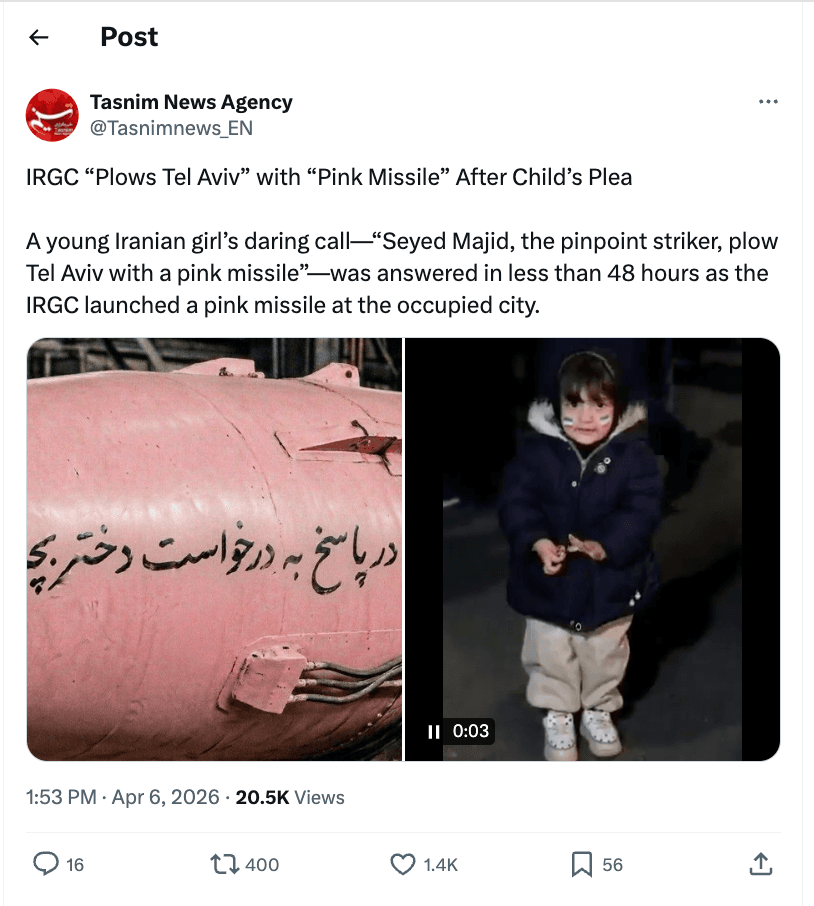
This led to an organic-looking wave of user-generated content, with many creating additional AI-generated images and videos featuring the little girl and the pink missile.
The state-driven propaganda machine takes over
The initial success of the campaign going viral on social media prompted the launch of a coordinated “Pink Missile Campaign“ across the Islamic Republic’s official and semi-official media channels.
The Iranian Diplomatic and Embassy accounts, which have become the centre of Iran’s foreign information operations, started to get involved.
https://x.com/iraninmalaysia/status/2041447517838291254?s=20
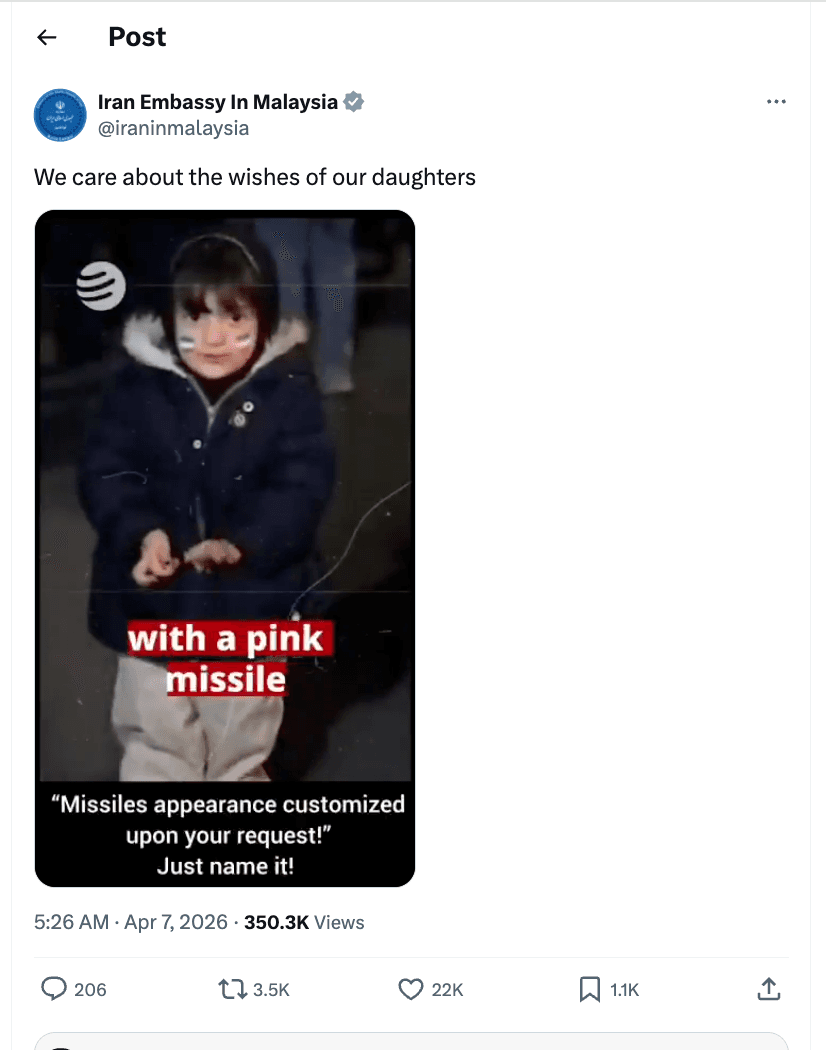
The video was broadcast across state media platforms, including SNN, Press TV, and on the social media accounts of diplomatic missions, such as the Islamic Republic Embassy in South Africa. The featured video included the original clip of the little girl alongside the fake, AI-generated photo of the pink missile.
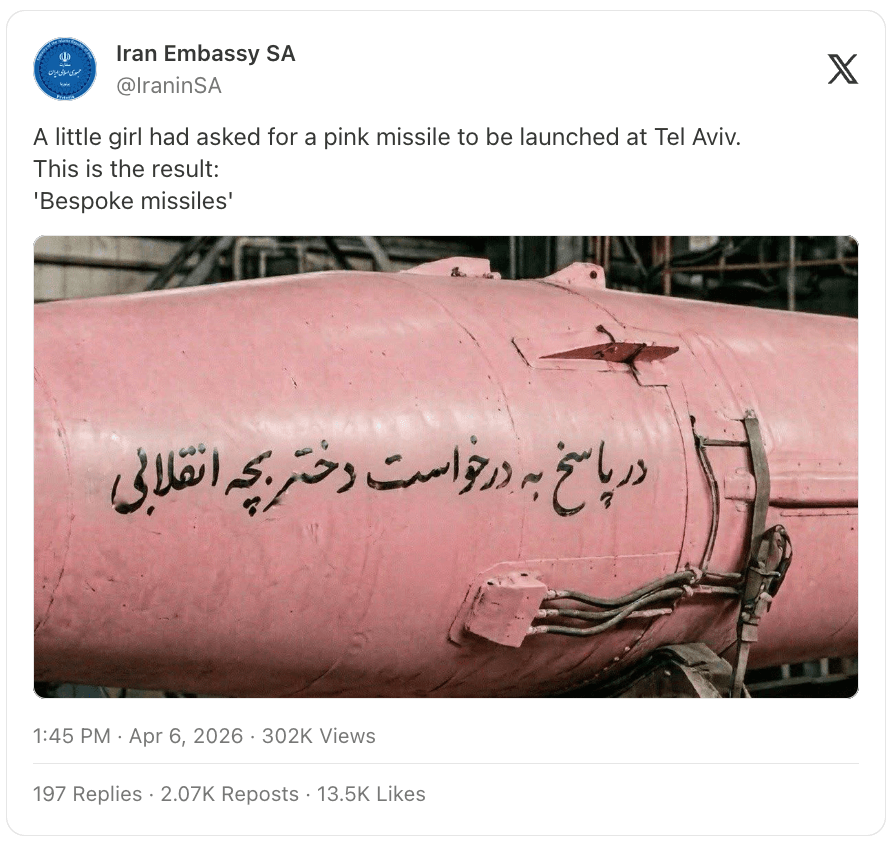
State-affiliated accounts on Telegram, a key distribution network for government narratives, widely shared the fabricated story and the pink missile launch. Since the publication of the first clip on Telegram on April 4th to date, “pink missile” in Persian has been mentioned over 300 times on Telegram and reached close to a million accounts.
The campaign goes international
The campaign’s reach extended beyond domestic borders, becoming so widespread that it penetrated international media landscapes, demonstrating the effectiveness of the digital-first disinformation strategy.
The Russia Today (RT) account on X posted a video that combined the girl’s clip, the fake missile photo, and an English translation of a slogan allegedly written on the missile, further validating the narrative for a global audience.
The Jerusalem Post reported on the event, explaining how the IRGC had supposedly painted a missile pink in response to the Iranian girl’s request. Crucially, the article included the same fake, AI-fabricated image of the pink missile as its lead photo, unwittingly lending credibility to the propaganda campaign.
A Yemeni Cartoonist, Kamal Sharaf, drew a cartoon depicting the pink missile waving to Iranian schoolgirls, a reference to children who had died in the air-strike on the Shajareh Tayyebeh school in Minab. The cartoon was then further amplified by the Iranian Embassy accounts and the Quds News Network.
The campaign’s “Success” and follow-Up
On April 8, videos started to be shared across Telegram and X with the same little girl, now holding a printout of the fake pink missile photo, thanking Seyyed Majid Mousavi, “Uncle Majid, thank you, thank you, I love you very much.” This video served to close the emotional loop of the story and reinforce the image of people and the nation serving the IRGC.
Writing slogans on missiles: a propaganda tradition
The “Pink Missile” campaign is not an anomaly in Iran. It is part of a digitally-enhanced iteration of a long-standing propaganda tradition within the Islamic Republic of writing slogans and messages on missiles.
This practice transforms military hardware into an explicit medium for ideological and diplomatic messaging. The missile is no longer solely a weapon of war; it is a platform for state propaganda.
The tradition in Iran dates back to the early years of the Islamic Republic. An old photo from the eight-year Iran-Iraq War shows Hassan Tehrani Moghaddam, one of the founders of the IRGC missile program, personally writing anti-American slogans on a missile, establishing the practice as a key component of wartime morale and ideological expression.
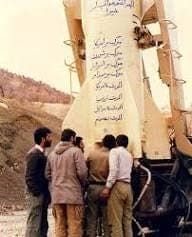
Writing slogans has continued throughout the decades as a tool of propaganda, visibly deployed during major military operations such as Operation True Promise and the 12-day war, with numerous images published across media channels.
Modern propaganda themes: revenge, gratitude, and banter
During the recent conflict, the slogans on missiles, real or fabricated, reflected several key propaganda themes:
Revenge: In the early days of the conflict, the dominant theme was “revenge,” notably vengeance for the death of Ali Khamenei, the leader of the Islamic Republic, on the first day of the 40-day war.
Reactionary messages: Many messages were reactive, acknowledging the sacrifices of war or thanking domestic supporters.
Commemoration: Slogans were used to commemorate victims, such as “In memory of the girls of Minab school“ or “On behalf of dear Amir Hossein and Iliya Sharifi.”
Public gratitude: Slogans were directed at supporters who attended night-time demonstrations, such as “Honorable people of Iran, your message has been received,” underscoring the government’s concern about maintaining control of the streets.
Intimidation: A significant portion of the messages were aimed at boasting about military capabilities or humiliating adversaries:
- Technological Claims: Assertions of advanced capabilities, such as “Radar stealth? I don’t think so. I am the only radar stealth.”
- Regional Warning: Even after the ceasefire, warnings were issued to regional powers, such as the message written on a missile: “Habibi! America is leaving. It’s just us and you.”
The “Pink Missile” campaign serves as a stark illustration of the Islamic Republic’s sophisticated and adaptive war-time digital propaganda machine. They leverage state-controlled access during an internet blackout and exploit emotionally charged AI-fabricated narratives combined with coordinated social media campaigns to successfully monopolize the narrative domestically and internationally. This case study demonstrates how traditional Iranian propaganda, such as writing slogans on missiles, has been digitally enhanced and weaponized with artificial intelligence to manufacture consent, mobilize support, and project ideological messages globally.
The campaign’s rapid success, reflected in international media coverage, underscores the potent threat that digital authoritarianism, particularly when amplified by AI and shielded by internet blackouts, poses to the integrity of independent information and public discourse.