The Economic Impact of Internet Shutdowns in Iran
Iran has been under an internet and communication blackout for 47 days.
On April 12th, 2026, during a meeting at Iran’s Chamber of Commerce, Afshin Kolahi, the head of the Knowledge-Based Commission mentioned “the direct damage of internet shutdowns in Iran between 30-40 million [USD] per day, and with indirect damages, it is as high as 70-80 million [USD] per day.”

https://x.com/IranChamber/status/2043702624248037857?s=20
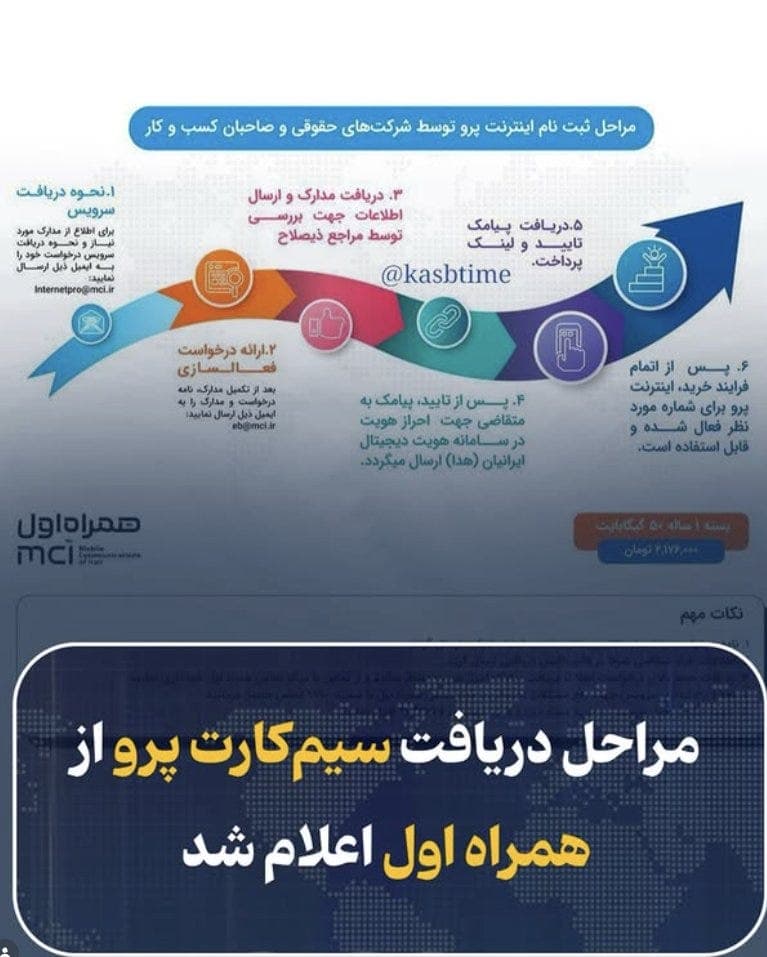
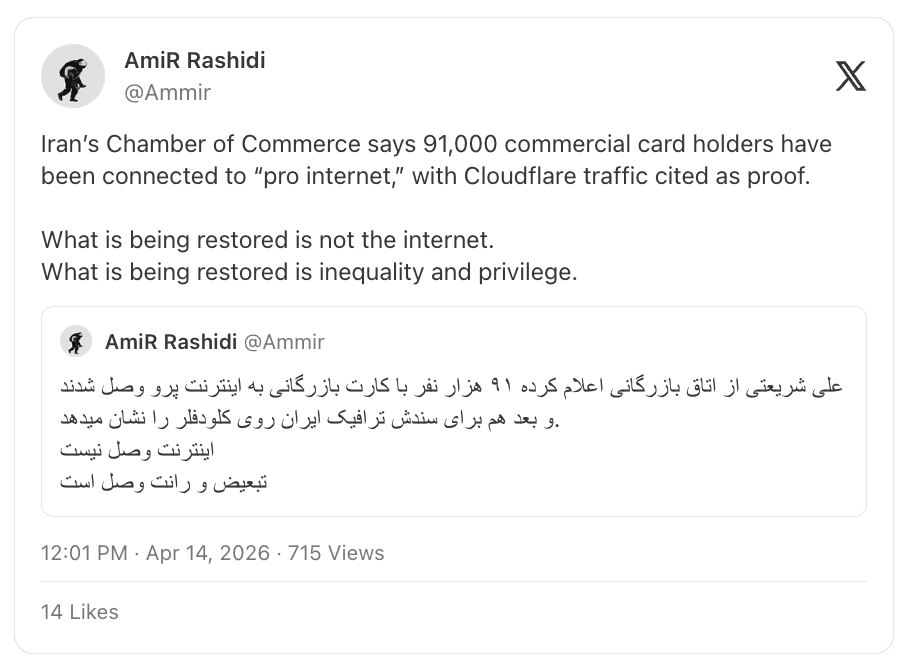
Last week, state-backed telecommunications companies in Iran started to roll out a program called “Pro Internet” to grant access to selected businesses. On April 13th, 2026, Iran’s Chamber of Commerce confirmed that 91,000 commercial cardholders in Iran will receive notification to register for “Pro Internet” services.
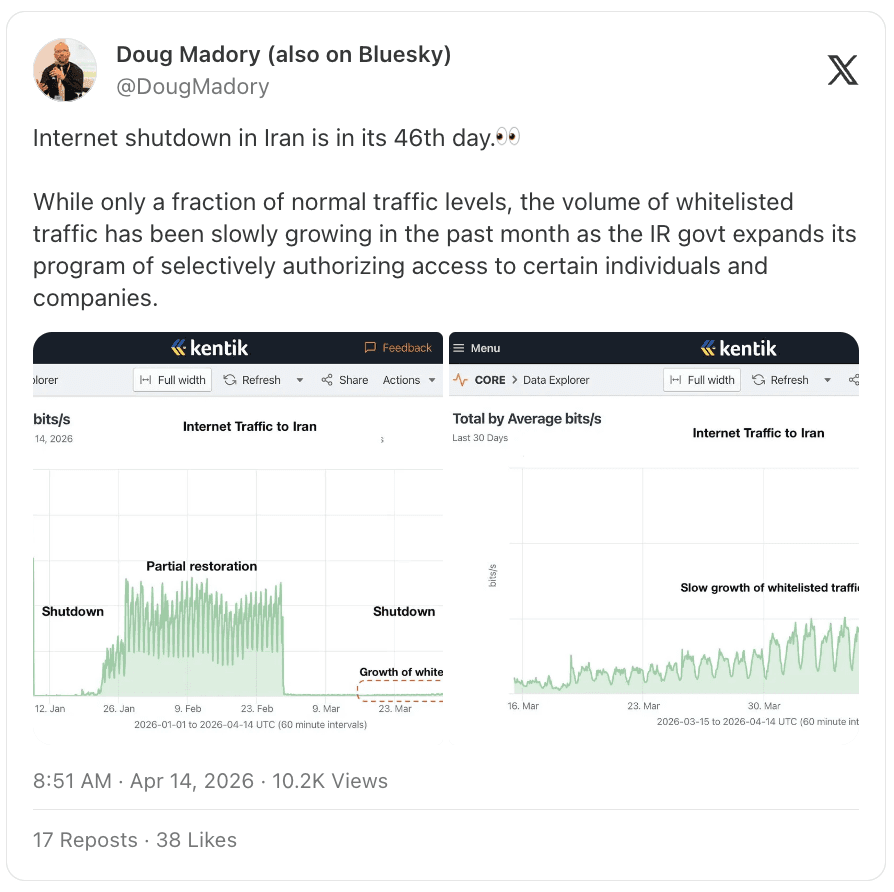
As a result of this program, the volume of whitelisted traffic has slowly but steadily increased, even though the overall traffic from Iran still remains low.
The “Pro Internet” program was first reported by Digiato, a technology news website in Iran, in late February. The announcement came only days before the start of the war.
According to Digiato, the program was initiated after meetings between digital economy organizations and high-ranking officials after the internet shutdowns in January lasting close to 20 days. The program’s purpose was to ensure commercial users have stable access to the internet even during international internet disruptions.
At the time, Factnameh looked at the impact of internet shutdowns on Iran’s economy. With the country’s economy already under pressure from long-term sanctions, political instability, and widespread corruption, internet shutdowns have further deepened existing problems. The announcement of the “Pro Internet” packages comes in the context of Iran’s longest internet shutdown.
The direct cost of Internet shutdown
During the meeting at Iran’s Chamber of Commerce, Afshin Kolahi compared the economic cost of internet shutdowns to the cost of constructing the B1 bridge, recently destroyed by US airstrikes, and the estimated cost of building power plants. Concluding that the financial damage of the internet disruption, which was carried out by Iran itself, is significantly greater than the damage inflicted on the country’s infrastructure during the war.
“A bridge like the B1 bridge costs about $15 to $20 million to build. A power plant, I think, costs between $1 and $3 million per megawatt. I am basing this on research. The direct damage from internet disruption, according to estimates, is between $30 and $40 million per day. We are not aware that another part of our infrastructure that is not visible, and whose destruction we do not see, is being lost. Direct $30, $40 million, indirect the same amount, $70, $80 million per day. This means we are losing four B1 bridges every day. We are losing two medium-sized power plants a day, and we are doing this ourselves.”
According to the latest official estimates by the Ministry of Communications, the daily damage of internet disruption to Iran’s economy is about five thousand billion Tomans. The details of calculating this number are not clear, but it is based on the statements (archived link) of Sattar Hashemi, the Minister of Communications, on January 26, 2026, after the last period of internet shutdowns in Iran. At the time he said that “based on the initial estimate of the strategic deputy of the ministry, the damage of internet disruption to the “core of the digital economy” is 500 billion Tomans per day, and the damage to the overall digital economy, including side effects, is 5 thousand billion Tomans per day. He emphasized that the Minister of Economic Affairs believes that the amount of damage from internet disruption is greater.

https://x.com/indypersian/status/2016524989177200649?s=20
Considering the average dollar exchange rate in the Central Bank’s currency and gold exchange center in January (131,000 Tomans), the amount of damage from internet shutdown is estimated to be around 38 million US dollars. If we calculate the average exchange rate (156,000 Tomans) in the free market in January, the amount of damage is about $32 billion (USD).
This figure is very close to what Mr. Kolahi declared as the direct damage of internet shutdowns. It is also consistent with Factnameh’s calculations based on the share of the digital economy’s value in Iran.
The International Monetary Fund, in its latest estimate (April 2026), estimated Iran’s Gross Domestic Product (GDP) in the last calendar year to be $371.2 billion. This amounts to $1.17 billion per day. On the other hand, according to the latest official estimates, the share of the digital economy in Iran is currently estimated to be about 4%.
On February 1, 2026, Ehsan Chitsaz, the Deputy for Policy-making and Planning of ICT Development and Digital Economy at the Ministry of Communications, said “The digital economy, which once accounted for about 4.72 percent of the gross national product, has now decreased to about 4 percent.” He did not mention the reasons for the decline, but it can be said that frequent and prolonged internet disruptions could be one of the reasons for this phenomenon.
However, even if we consider this 4%, the amount of added value generated in the digital economy sector reaches about 40 million dollars per day.
Considering this ratio, the value of the digital economy reaches about $40 million per day. That is, with the internet shutdown, the vital artery of a part of the economy, valued at $40 million per day, is practically affected.
Here is how formula Factnameh uses to calculate the cost of internet shutdowns in Iran:
Share of the digital economy in the national GDP x Iran’s Daily GDP = Daily Digital economy value
4 percent x 1,016 Million (USD) = 40.64 Million (USD)
From the beginning of 2026 until the time of writing this report, the internet has been shut down for 66 days in Iran. The January internet shutdown lasted 20 days, and the current shutdown has lasted for 46 days since the start of the war on February 28. With this in mind, the direct damage from internet disruption so far has exceeded $2.5 billion. But this is not the whole story. To calculate the total cost of the shutdown, we need to also look at the indirect damage to the economy.
The indirect damage of internet shutdown
There is no documented report or official comment on the damage of internet disruption to other economic sectors. But there is a lot of evidence and indications that this damage is significant.
One such piece of evidence is the statements (archived link) of the Minister of Communications himself on January 26, 2026, who referred to “the employment of about 10 million people directly and indirectly in the field of digital economy.”
Another example is a report (archived link) titled “Internet disruption; damage beyond the numbers for Iran’s digital economy,” which was published on Asr Iran website on February 7, 2026. This report refers to some businesses that are outside the scope of the digital economy but suffer from internet disruptions and shutdowns. For example, the report mentions the advertising and publishing business and quotes the CEO of a major advertising company:
“Initial estimates show that more than 90% of publishers faced a minimum of 70% drop in revenue during this period; a statistic that indicates an unprecedented slump in the online advertising market.”
This report and similar reports published in the public domain do not mention a specific figure for the damage, but what is clear is that internet shutdowns have caused significant damages to a wide variety of economic sectors.
The economic and social impact of Internet Shutdowns
Based on Factanemeh's calculation, we estimate the cost of the current internet shutdown to the Iranian economy to be around 40 million USD per day. Which means that the direct damage from the current internet shutdown exceeded 2.5 billion USD.
With the available information, accurate estimation and calculation of the indirect damage of internet disruption to other businesses is not possible, but media reports from inside Iran show that many businesses have been indirectly harmed by internet disruption. The extent of this damage seems large enough that the amount of indirect damage from internet disruption can be assessed as being in the range of direct damage.
Beyond direct financial losses, prolonged internet shutdowns create long-term damage that is harder to measure. As the internet shutdown continues, more small and medium businesses will endure losses that are beyond their ability to recover, forcing them to close permanently even after access is restored. Extended shutdowns also lead to layoffs, declining motivation among business owners, and a shrinking labour market as a result of increased emigration.
Taken together, the data show that internet shutdowns in Iran are not short-term disruptions but repeated shocks to the economy. Each shutdown adds to existing problems, pushing more businesses toward failure, increasing job losses, and encouraging skilled workers to leave the country. Over time, the damage goes beyond lost income. Frequent and prolonged disruptions weaken trust in Iran’s digital infrastructure and make long-term investment less attractive.
In practice, internet shutdowns can not just be seen as a tool to control flow of information and limit communications but a policy choice that steadily harms the country’s economy and limits future growth. The Iranian government’s “whitelisting” of internet access has created a heavily restricted digital environment.
This controlled expansion is driven by the state’s need to maintain essential government functions, international finance, and key approved industries. The recent growth in internet traffic does not signal a general relaxation of controls, but rather an effort to fine-tune the minimum global connectivity required to prevent the collapse of vital economic services. The whitelisting’s goal is to enable controlled economic activity while retaining absolute informational control.
This control has led to a sprawling ecosystem of information manipulation to shape narratives around the war. The blackout of international internet access severely limits the public’s access to independent and verifiable information, while selected individuals and entities are whitelisted to have unfettered access to the internet. By deliberately cutting off connectivity, the Islamic Republic is isolating the population, making it significantly easier to monopolize the narrative around the war to shape public opinion and silence dissenting voices.
The deliberate restriction of internet access by the Islamic Republic serves multiple strategic purposes, including to allow them to monopolize the narratives surrounding the war. This control has created an extensive system of information manipulation. By severely limiting the general public’s access to independent and verifiable information, while granting select individuals and entities unfettered internet access, the state isolates the population. This isolation simplifies the task of shaping public opinion, controlling the narrative, and effectively silencing any dissenting voices.