The Iranian F-5 Strike in Kuwait: Fact or Fiction?
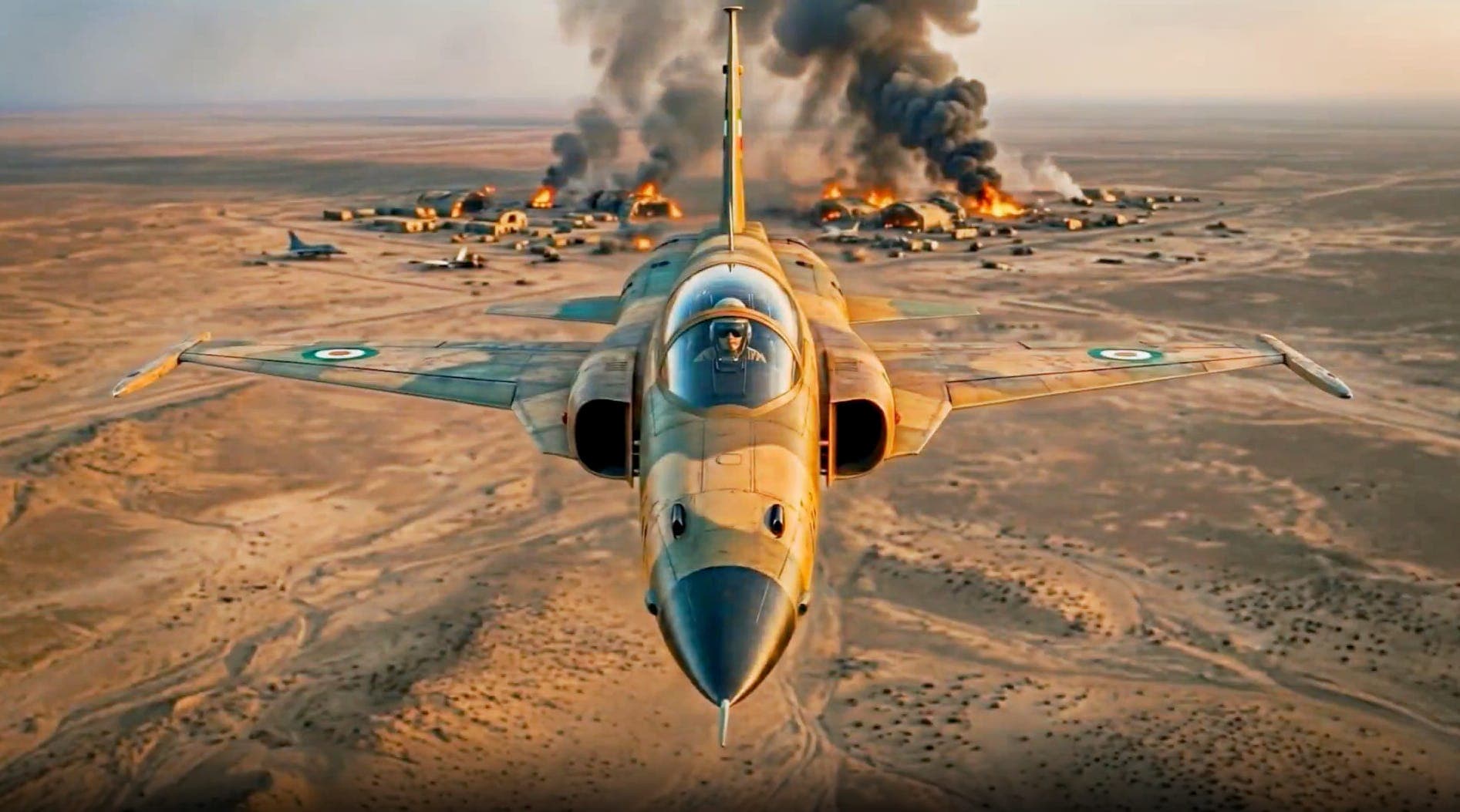
Recently, an NBC News report sparked a frenzy of media attention and speculation by claiming an aging Iranian F-5 fighter jet successfully bombed the US military’s Camp Buehring in Kuwait. Following this report, Iranian state-affiliated media and military officials quickly embraced the narrative, celebrating the supposed daring mission of an Iranian pilot—despite having made no official mention of such an operation before the NBC broadcast.
But is there any truth to this scenario? Let’s dive into the facts and separate the military reality from the myth.
The Claims and the Echo Chamber
The NBC report, which relied entirely on anonymous US government sources, provided no visual evidence, operational details, or official confirmation from either the US or Kuwait regarding an F-5 jet. Nevertheless, Iranian officials, such as Army spokesperson Brigadier General Mohammad Akraminia, implicitly confirmed the claim on television, calling it an “unprecedented” success where an F-5 allegedly bypassed multiple layers of American air defenses.
Meanwhile, social media is filled with unverified rumors. Some speculated about Kuwaiti friendly-fire incidents in the chaos, while others shared AI-generated fake videos claiming to show the aftermath of the F-5’s destruction.
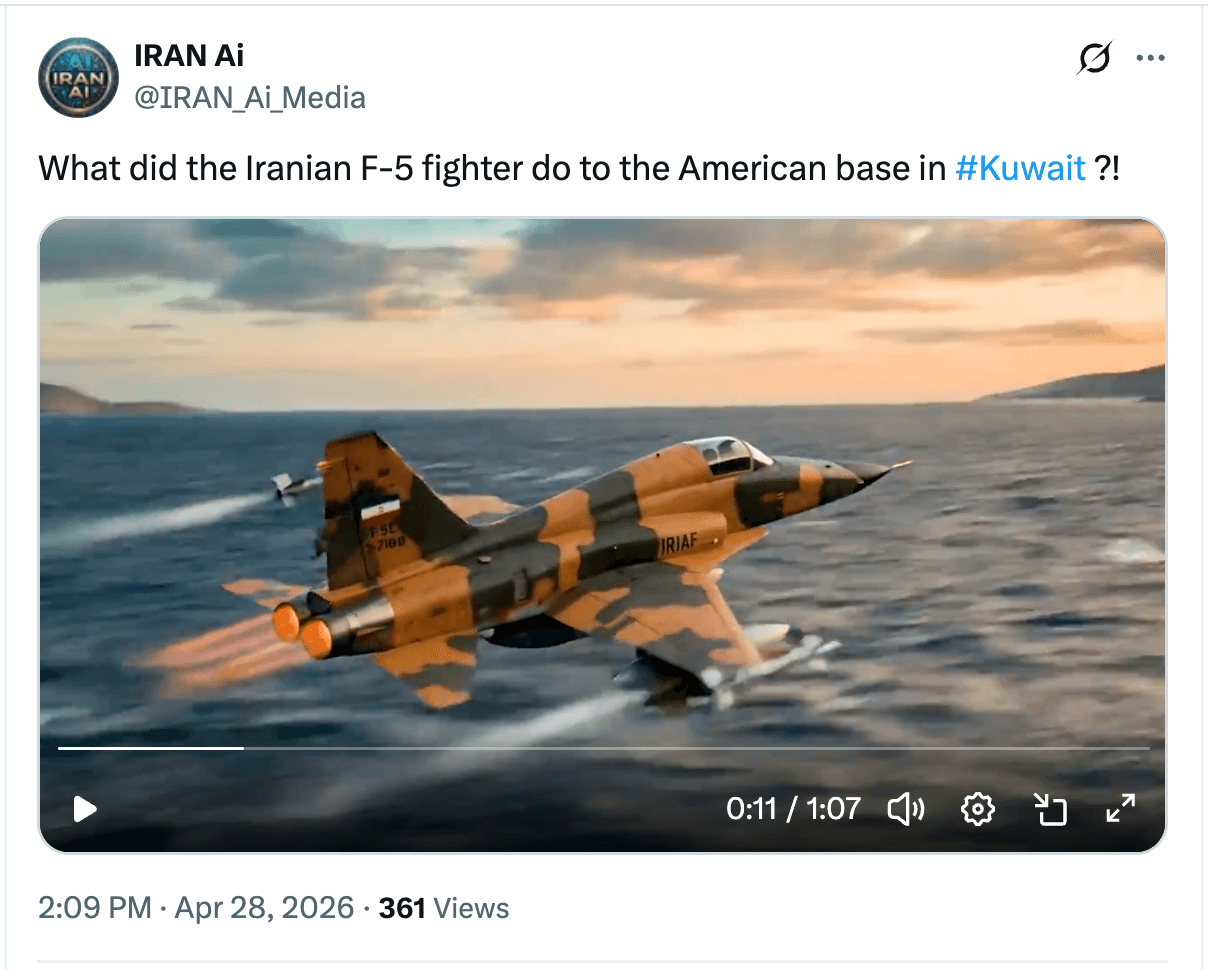
https://x.com/IRAN_Ai_Media/status/2049189345366520179?s=20
Above: Iranian AI-generated video simulating the attack.
The Reality of the Attack on Camp Buehring
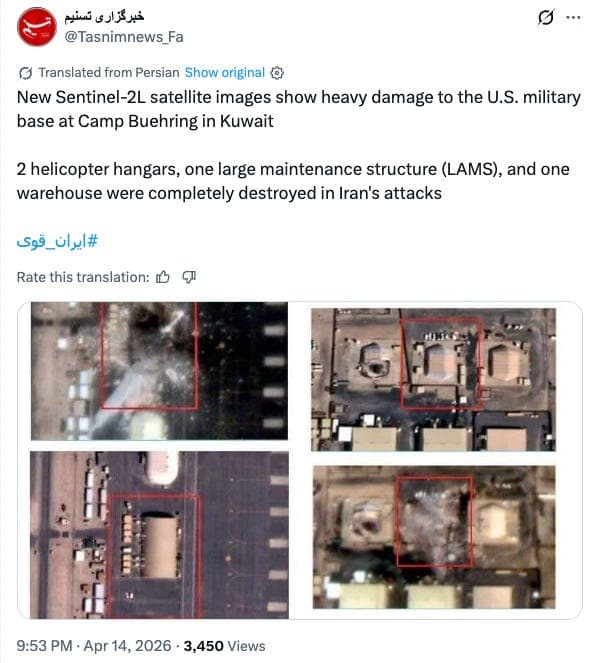
While the F-5 story is highly questionable, an attack on Camp Buehring did actually occur. Sentinel-2L satellite imagery confirmed severe damage to the base, destroying two helicopter shelters, a large maintenance structure (LAMS), and a warehouse.
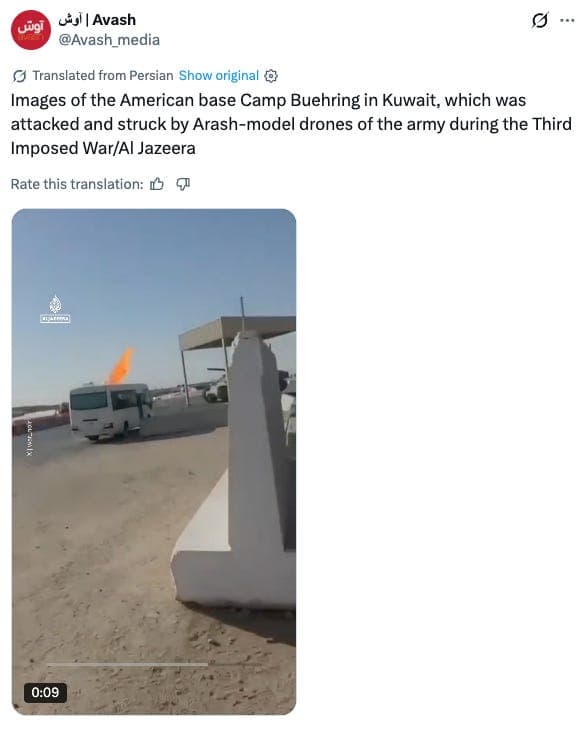
However, before the NBC report emerged, the prevailing narrative among Iranian sources was that this attack was carried out by “Arash” suicide drones, not a fighter jet. Using drones aligns much better with Iran’s established attack patterns, as it is cheaper, highly repeatable, and poses significantly less risk than sending an outdated manned fighter into heavily defended enemy airspace.
The Technical Reality: Why an F-5 Strike is Highly Improbable
From a military standpoint, a successful F-5 infiltration into US and Kuwaiti airspace is practically impossible. The F-5 Freedom Fighter/Tiger II is a lightweight, 1960s-era jet designed as a cheap, agile option for US allies. While it can carry up to 7,000 pounds of payload, its design is incredibly simple, and Iranian F-5s cannot launch precision-guided or standoff weapons.
To hit a target, an F-5 would have to fly directly over the base at a very low altitude and drop unguided Mk 80 series bombs (like the Mk 82, 83, or 84). Because of the low altitude, these bombs would need to be equipped with retarder kits (such as Snake Eye fins or ballutes) to drastically slow the bomb down, giving the aircraft a chance to escape its own blast radius.
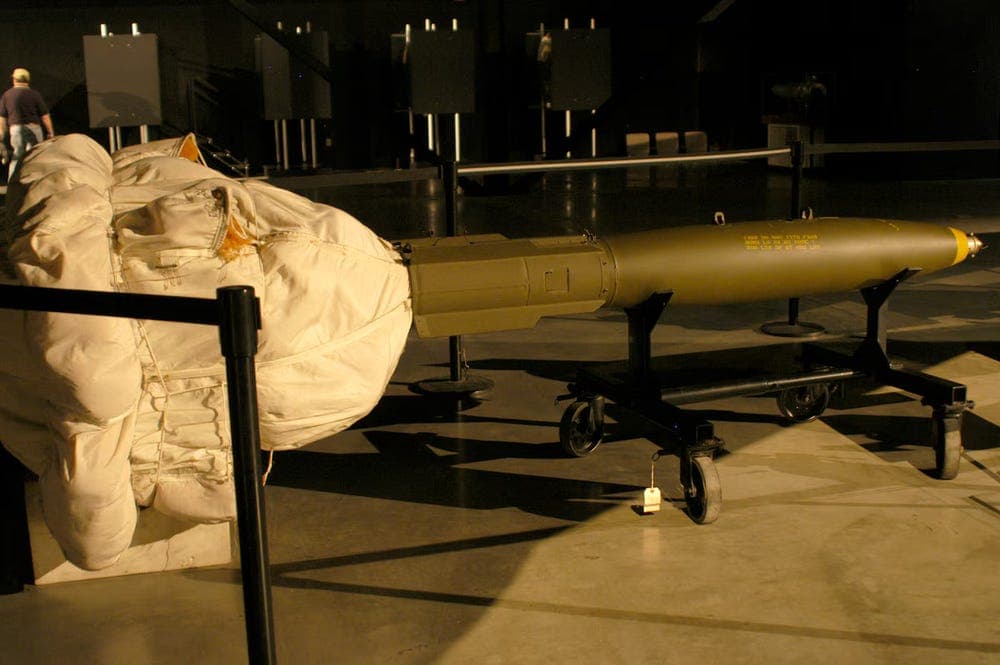
MK82 free-fall bomb equipped with a balout system
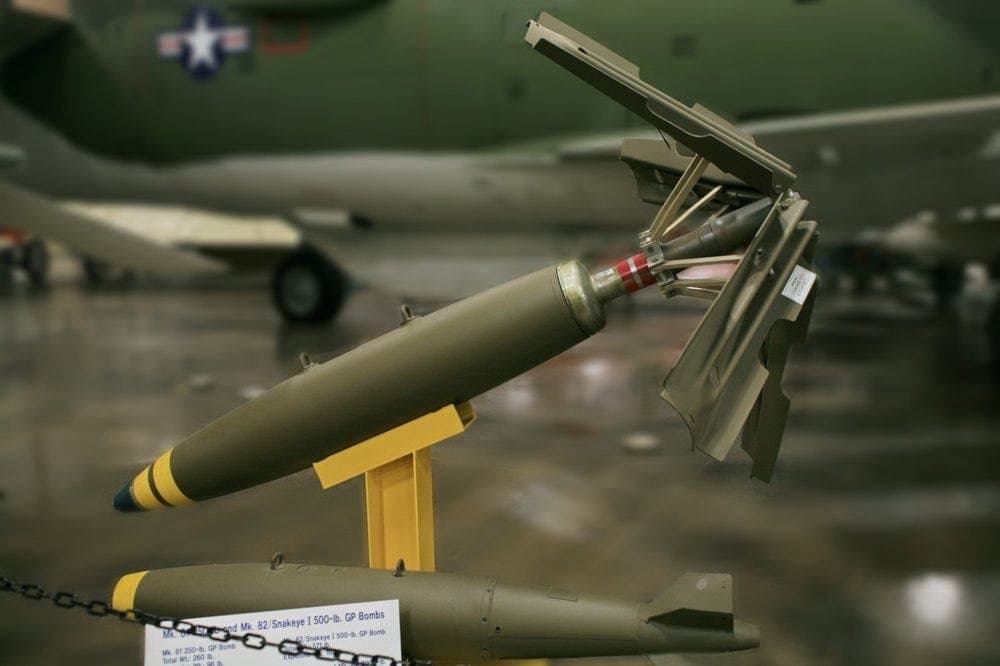
MK82 free-fall bomb equipped with Snake Eye system
Relying on unguided bombs drastically increases the margin of error, especially in a high-stress environment where modern air defenses are actively targeting the pilot.
The Impenetrable Defense Network
The geography of southwestern Iran and the Persian Gulf is flat, offering excellent, unobstructed radar coverage for both ground-based systems and airborne early warning (AWACS) aircraft. Identifying a non-stealthy, third-generation jet like the F-5—built with 1970s technology—would be incredibly easy.
Furthermore, baseline F-5 jets lack modern electronic warfare systems, modern jammers, or adequate chaff and flare dispensers. An F-5 attempting this run would be flying into a multi-layered defense network consisting of Patriot missiles, Stinger MANPADS, Avenger short-range systems, and modern interceptor jets (like F-15s, F-16s, and F-22s). Without escort fighters or electronic cover—which Iran cannot provide—the mission is practically a suicide run.
History Repeating Itself
History shows us exactly how this scenario usually ends. During Operation Desert Storm in 1991, four Iraqi Mirage F1s attempted a similar low-altitude surprise bombing run on Saudi oil facilities. They were immediately detected by AWACS and shot down by Saudi F-15Cs using AIM-9 Sidewinder missiles before they could even get close to their target.
Similarly, during the recent conflict, two Iranian Su-24 Fencers—aircraft with much better penetration capabilities and range than the F-5—were shot down by Qatari F-15QAs before reaching the Al Udeid base in Qatar.
The narrative of a 50-year-old F-5 jet penetrating a state-of-the-art, integrated US air defence network is compelling, but it simply does not hold up under military scrutiny. The risk of detection and destruction is overwhelmingly high. The destruction at Camp Buehring was very real, but if we follow the evidence and military logic, it was almost certainly the work of suicide drones or ballistic missiles—the true, cost-effective staples of modern asymmetric warfare.