The 30-Million Myth: Iran's Fabricated Loyalty Campaign
The Iranian government boasted that 30 million citizens joined a state-sponsored loyalty campaign. Exposed database IDs and unnatural growth graphs tell a very different story.
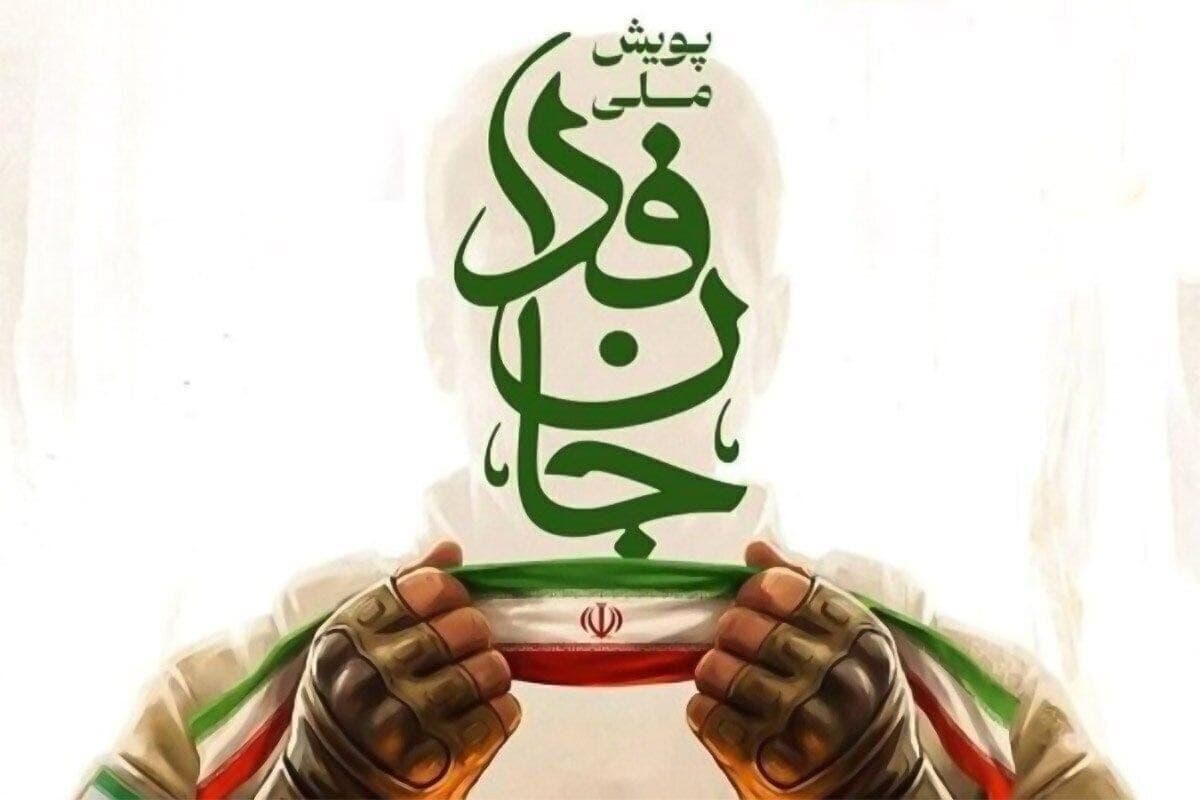
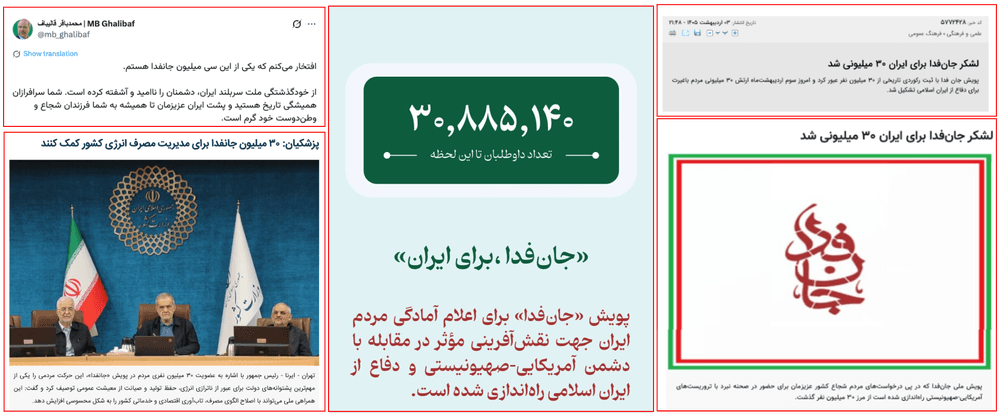
Officials and state media in the Islamic Republic recently made a staggering claim: over 30 million Iranians have joined a campaign called “Janfada” (meaning “those who sacrifice their lives”).
But is this massive show of state support real, or is it a calculated fabrication? Let’s dive into the data.
Co-opting a Protest Movement
The term “Janfada” and “Janfaday-e Mihan” was heavily used by protesters and opposition media to honour the victims of the bloody state crackdowns in January 2026 (Dey 1404). Just three months later, the IRGC—the very force responsible for suppressing those protests—launched a state-sponsored loyalty campaign using the exact same name.
The campaign, spearheaded by the IRGC’s “Baqiyatallah” socio-cultural headquarters, targets Iranians over the age of 12. It invites them to register their support for the Islamic Republic and its Supreme Leader via websites, SMS, and physical booths.
But the math simply does not add up. Here are five reasons why the 30 million figure is mathematically and technically impossible.
1. The Demographic Improbability
According to population estimates, there are roughly 60 million Iranians over the age of 12. The government is asking us to believe that one in every two eligible Iranians voluntarily registered to support the regime. Given the immense social tensions and the violent suppression of recent widespread protests, such overwhelming, voluntary public support is highly unbelievable.
2. The <4 Million Backend Revelation
The campaign’s website, janfada.ir, features a live counter but provides zero verifiable data or transparency. By inspecting the website’s backend data, Ali Sharifi-Zarchi, a former assistant professor of bioinformatics at Sharif University, discovered that the unique identification (ID) number for the latest user comments was under 4 million. To support his claim, he invited users to run a command to retrieve the raw data from the website’s comment page. By running this command, the displayed comments are returned in a JSON file format:
curl -s ‘https://janfadaa.ir/ajax’ --data-raw ‘action=getComments’ | jq
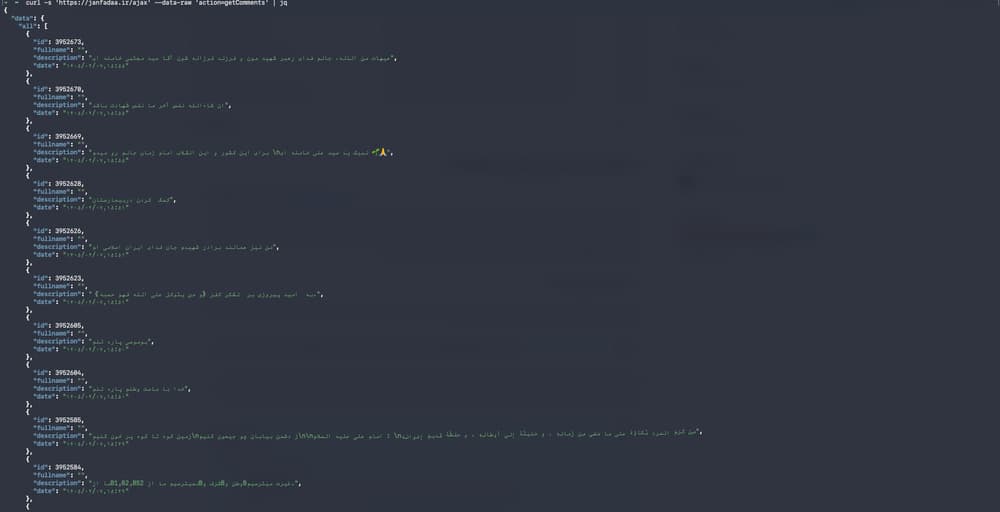
The image shows the result of running this command at 12:30 a.m. on Ordibehesht 8, indicating that the ID number of the last comment displayed on the site is 3,952,673.
Islamic Republic supporters and state media pushed back hard. Outlets like Faraz Daily argued that the IDs represented the number of comments, not the number of registered users.
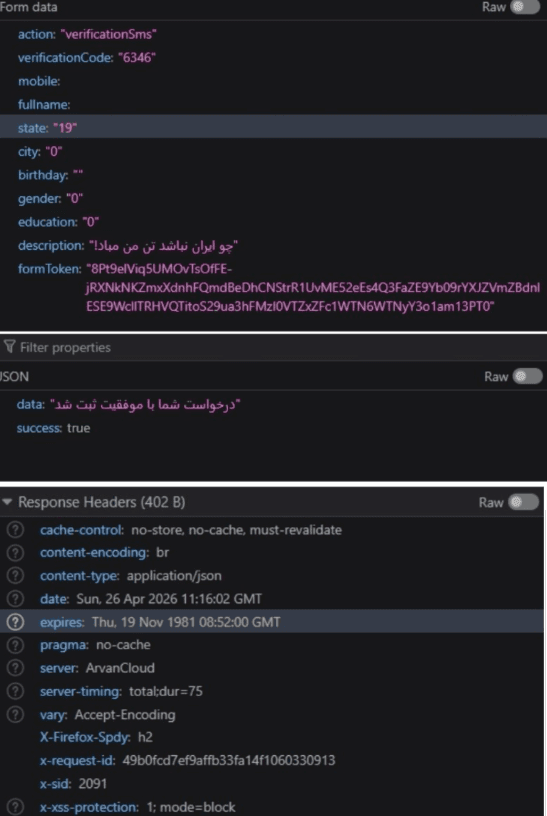
However, technical experts debunked this defense. In a simple database design, creating a separate ID system just for comments on a basic registration form is completely illogical. The site doesn’t assign a separate user ID; the ID used to pull approved comments is almost certainly the exact same sequential ID generated when a user registers. This heavily implies that the total number of actual entries in their database is less than 4 million.
- The Impossible Linear Growth Curve
Organic campaigns do not grow in a straight line. You expect a massive spike during initial promotions, fluctuations during weekends or major news events, and a tapering off as the target audience saturates.
Yet, when analyzing the “Janfada” campaign’s daily reported numbers, the growth pattern was perfectly, unnaturally linear.
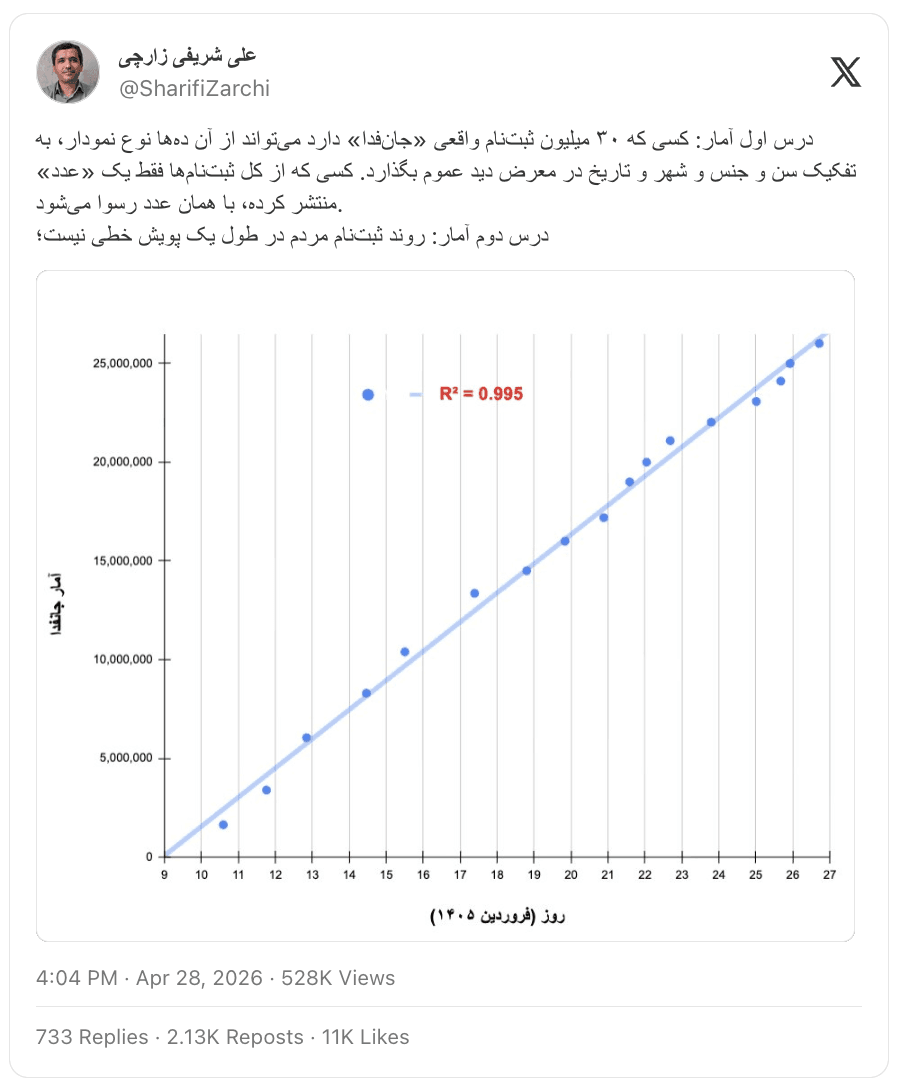
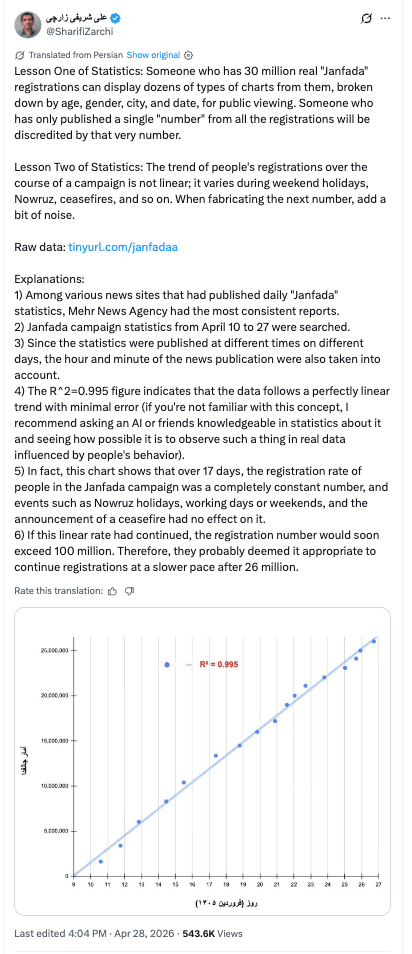
https://x.com/SharifiZarchi/status/2049218336639037590
We expanded this timeline and found the same glaring anomaly. The numbers increased at a fixed, robotic rate, entirely ignoring real-world variables like advertising pushes or weekends. At one point, the trajectory angle shifted, but merely transitioned to another perfectly straight, fixed-slope line.
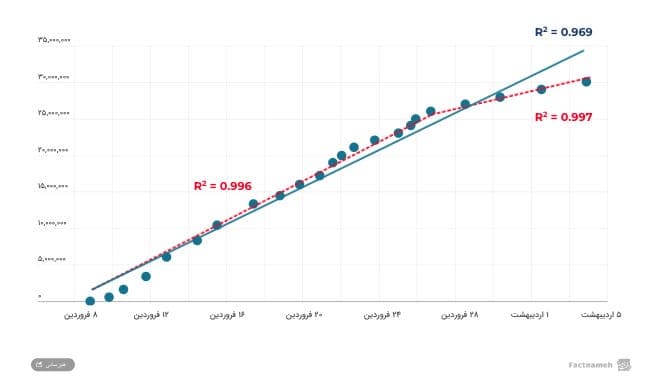
Distribution of the aggregated “Janfada” campaign statistics, based on figures published by Mehr News Agency between March 28 and April 23.
When contrasted with the actual, erratic distribution of the 1,654 comment IDs extracted from the backend, the difference between human behaviour and the fabricated public counter becomes incredibly obvious.
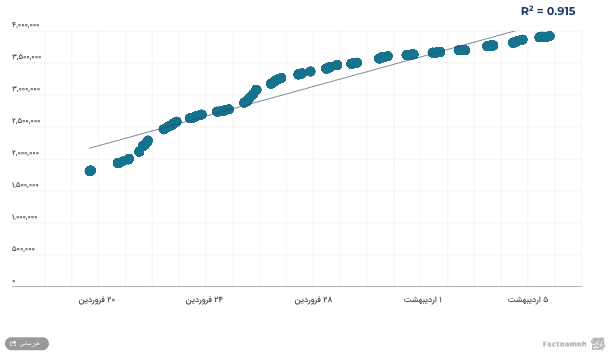
Distribution of aggregated statistics from 1,654 IDs on the janfada.ir website, based on data from 1,654 comments published between April 8 and April 25.
- Flawed Registration Mechanisms
Even if the database holds 4 million entries, that does not mean 4 million unique people have registered.
To join the campaign, a user only needs to provide a phone number (or an email address for the international site, janfada.net).
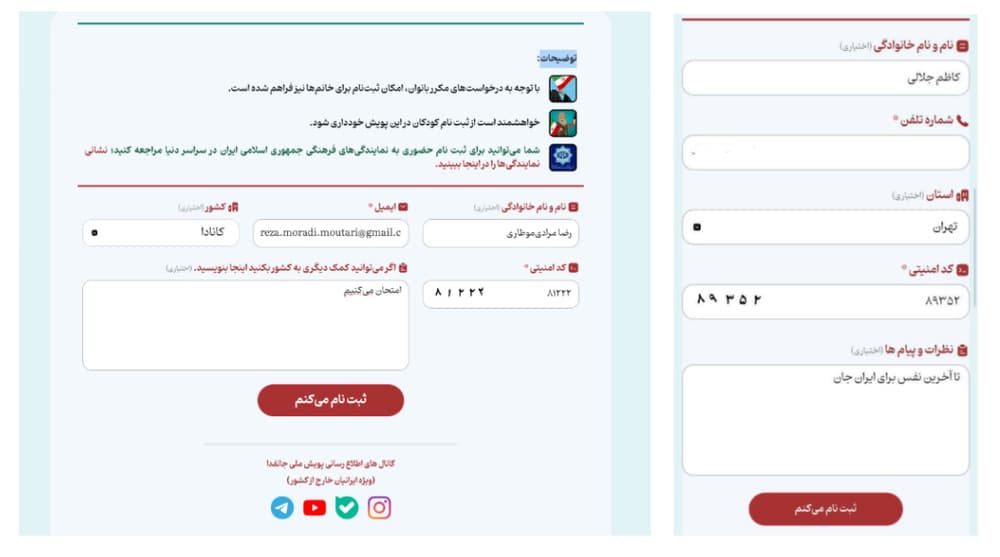
Right: An image of the registration page of janfada.ir, shared by Kazem Jalali, Iran’s ambassador to Russia. Left: an image of the registration page on janfada.net, where we tested the sign-up process.
The system lacks basic duplication checks. Any individual can register multiple times simply by using different phone numbers, email addresses, or a combination of both. A single enthusiastic supporter could easily generate dozens of entries.
- A Complete Refusal of Transparency
Despite massive public skepticism, the campaign organizers have entirely refused to release anonymized, verifiable data. When the 30 million figure was challenged, the campaign spokesperson abruptly shifted to claiming there were 7 million comments submitted, offering zero proof to back up this new, equally inflated number.
The Verdict
The claim that 30 million Iranians joined the “Janfada” campaign is definitely false.
It is a fabricated statistic designed to project an illusion of mass consensus. From the demographic impossibilities and flawed registration mechanics to the exposure of backend database IDs and perfectly linear, bot-like growth curves, all evidence points to a regime digitally padding its own numbers. The real number of participants is unquestionably a fraction of the 4 million IDs found, let alone the 30 million claimed by the state.